
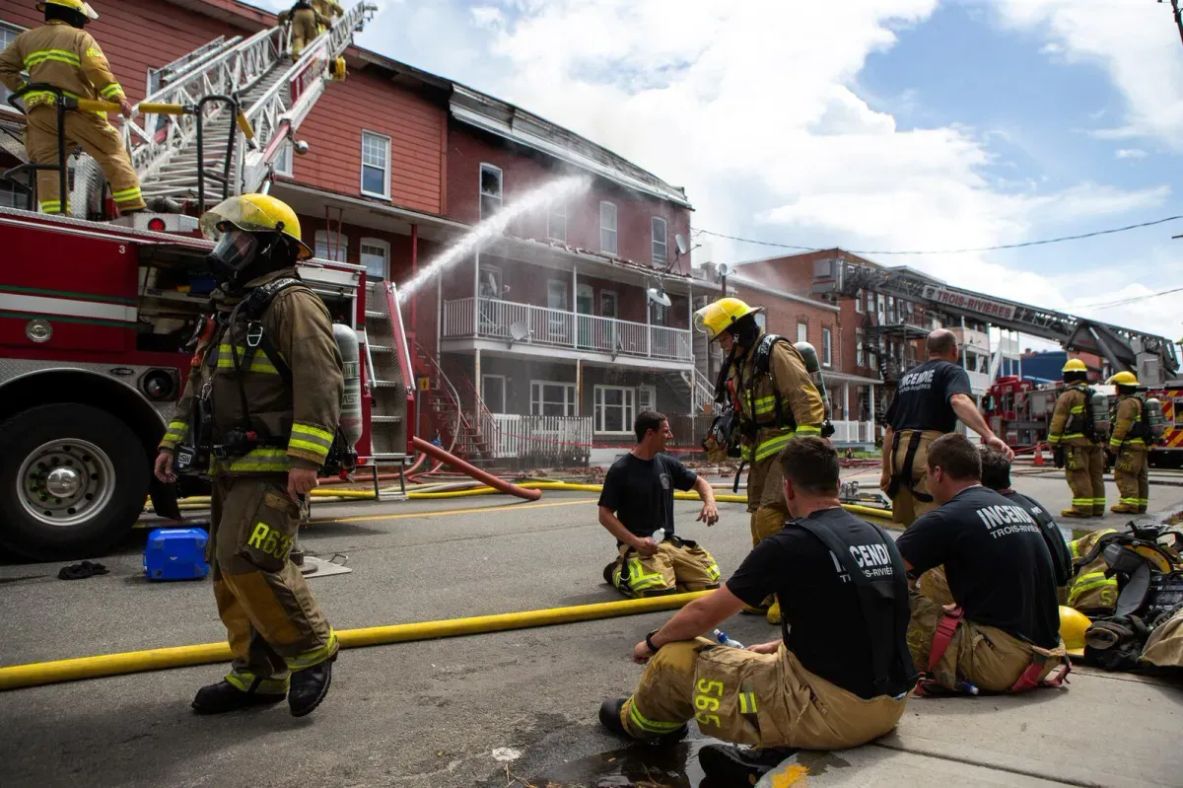
In Quebec, the 2015-2025 decade saw authorities crack down like never before on businesses that neglect fire safety: multi-million-dollar class action lawsuits, closure orders, daily fines climbing to $4,000 per violation, and even prison time in the most serious situations. The March 2023 Old Montreal fire (7 dead) triggered a $22M lawsuit against the owner and Airbnb; in Sherbrooke, the Albert Hotel was evacuated by order of the Superior Court because its detectors and exits did not comply with the Régie du bâtiment du Québec code. Rulings such as CFG Construction (a $300,000 fine upheld on appeal) and Recycle Gypse Québec inc. (2022 QCCS 4069) show that non-compliance is costly even before a fire breaks out. At the same time, the government strengthened the Fire Safety Act: mandatory sprinklers in seniors' residences in Quebec, a new Montreal by-law with fines of up to $4,000, and increased powers for municipal courts to order emergency work. Here is how these cases illustrate the five major risks (civil lawsuits, criminal/penal charges, closure, reputation, insurance costs) and how GCA Sécurité Incendie helps property owners stay compliant.

Why fire compliance is no longer optional
Since 2015, Quebec has applied a "zero tolerance" approach: any documented violation, out-of-service detectors, locked exits, lack of sprinklers, can trigger immediate statements of offence, a correction order, or an administrative closure. The National Fire Code of Canada (NFC) and the Building chapter of the Quebec Safety Code form the regulatory basis.
Added to this are:
- Schémas de couverture de risques (fire safety cover plans), which incur the civil liability of municipalities if improperly applied.
- The rare but real possibility of criminal negligence charges when lives are endangered.
Notable Case Studies
Old Montreal Fire (March 16, 2023)
- Toll: 7 dead, 9 injured, 1890 building illegally converted into an Airbnb rental.
- Violations: defective alarms, rooms without windows, absence of an evacuation plan AP NewsGlobal News.
- Consequences: $22M class action request against owner Me Benamor, the rental operator and Airbnb; criminal investigation ongoing Global NewsGlobal News.
39 statements of offence for out-of-service detectors, Montreal (March 2024)
- Radio-Canada revealed that inspectors issued 39 statements of offence (≈ $25,000) to a triplex owner for disconnected alarms and expired extinguishers. The case is going to municipal court: proof that fines are issued even without an incident.
Evacuation of Hôtel Albert, Sherbrooke (June 2022)
- The RBQ obtained an injunction requiring the immediate evacuation of 25 tenants; blocked exits, torn-down detectors TVA Nouvelles. The owner faces contempt of court and daily penalties.
CFG Construction inc. v. R. (Victoriaville)
- Charged with criminal negligence following the death of a worker, the company was fined $300,000 (2019), a sentence upheld by the Court of Appeal (2023 QCCA 1032) Dentons Health & Safety Law.
Recycle Gypse Québec inc. v. Ville de Delson (2022 QCCS 4069)
- The Superior Court upholds a municipal order requiring the correction of emergency exits and flammable storage Municipal litigation in Quebec. A reminder that judges support swift enforcement.
Municipal Liability (Court of Appeal, 2021)
- A city found partially liable for failing to adhere to its fire safety cover plan during a fire. Municipalities themselves can therefore be sued, prompting tighter inspections.
RPAs: Sprinkler deadline postponed, but penalties maintained
- The government has postponed the sprinkler installation deadline to December 2, 2027, while maintaining the threat of revoking certification from latecomers in Quebec.
Montreal By-law 12-005-1
- Any business open to the public is liable to fines of $1,000 to $4,000 for a first offence, doubled for a repeat offence.
3 months in prison for fire prevention code violations
- The owner of a residential building in Sault Ste. Marie was sentenced on December 14 to 3 months in prison after being found guilty of multiple fire code violations, according to a press release from Sault Ste. Marie Fire Services sent to the media on January 2, 2024.
Canadian example (Ontario, 2018)
- A Peterborough property owner was sentenced to 7 days in jail for missing detectors and blocked exits. Proof that a prison sentence remains possible.
Five types of risks for offenders
- Immediate financial: daily fines, legal fees, emergency work.
- Civil: class actions ($22M Old Montreal) or individual lawsuits.
- Criminal: criminal negligence (CFG Construction) or imprisonment (Peterborough).
- Administrative: forced closure, revocation of RPA (private seniors' residence) certification.
- Reputation & insurance: premium increases or refusal of insurance, loss of clientele.
Regulatory Trends 2015-2025
- Tightening of technical requirements: 10-year lithium smoke alarms, supervised alarm systems, LED exit lighting.
- Increased powers for municipal courts to order immediate corrective action.
- Provincial-municipal coordination: requirement for cities to update and implement their risk coverage plans.
- Post-2023 political pressure: stricter laws on short-term rentals to avoid a "new Old Montreal".
How to avoid penalties: the GCA Sécurité Incendie method
- Complete compliance audit: inspection of detectors, exits, evacuation plans, fire extinguishers, and alarm systems.
- Update of your fire safety plans in compliance with NFC regulations.
- Staff training (evacuation drills, monthly inspection rounds).
"Do you want to know if your building would pass an inspection tomorrow?" Contact GCA Sécurité Incendie for an evaluation and receive your evacuation plan or your emergency response plan in order to be compliant and avoid legal proceedings.
Conclusion
Ignoring fire safety has become a major business risk in Quebec. Documented cases, whether the horror of Old Montreal or a simple poorly maintained triplex, prove that owners, managers, and even municipalities can pay a heavy price: millions in damages, sudden closures, a ruined reputation, and in the worst-case scenarios, prison.
By investing in inspection and prevention today, you protect lives, your assets and your commercial future. GCA Sécurité Incendie is your best ally to remain compliant, reassure your tenants and sleep soundly.
Captain Bernier