
Laval, Laval
- Portable fire extinguishers
- Sprinkler systems
- Fire alarm
- +2 more services
Self-contained emergency lighting units must be inspected every month to make sure the lamps and batteries work, then tested every year to check the lighting duration and the recharge time. These checks can be done by the owner, their representative or a specialized firm. This page lists the businesses that offer emergency lighting and exit sign inspection in Quebec.
3 businesses found
Map of businesses
The interactive map appears when you interact with the page.
Laval, Laval
Montréal, Montréal
Québec, Capitale-Nationale

Previo
Your fire safety plan and your emergency response plan, online and always up to date.
Discover Previo
Evacuation drill
Planning, timing, debriefing and compliance report.
Plan an evacuation drill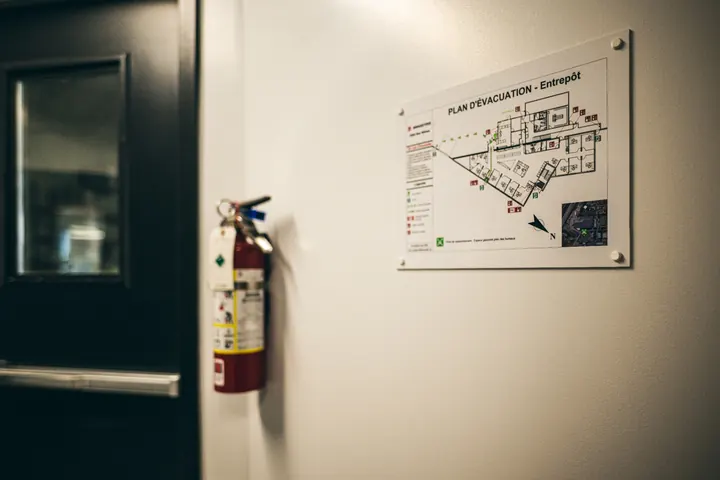
Custom plans
Our team prepares your custom evacuation plans.
See custom evacuation plans
Do it yourself
Evacuation plan, fire department intervention plan or hazardous materials plan, in a free application.
Create my plan for freeAccording to the RBQ inspection register guide, emergency lighting tests are described in Articles 6.5.1.6 and 6.5.1.7 of Division B of the National Fire Code of Canada (NFC) 2010 as amended for Quebec.
| Frequency | What is done | By whom |
|---|---|---|
| Every month | Inspection of self-contained units to make sure the lamps and batteries work. Units that are not self-contained are checked when the emergency power supply is started each month. | Owner, their representative or a specialized firm |
| Every year | Test of self-contained units to make sure they provide lighting for the required time and that the recharge time is compliant. | Owner, their representative or a specialized firm |
The results of these checks are part of the building's inspection register. In residential buildings, the RBQ states that exit stairs, means of egress and common corridors must have emergency lighting that can operate for at least 30 minutes in a power failure.
The frequencies shown summarize the inspection register guide (Guide sur la tenue du registre d'inspection) published by the Régie du bâtiment du Québec (RBQ), 2020 edition. Exact requirements depend on the building and its use, and the municipality or the insurer may require more. This page is general information and does not replace professional advice.
Before hiring, ask what report the business will give you after each visit, check that it holds valid liability insurance and, when the work requires a licence from the Régie du bâtiment du Québec (RBQ), that it holds the appropriate licence. Also ask about its experience with your type of building. If you also have exit signs to check or replace, see the list of services on each business's listing.
The directory badges help you narrow things down. The "GCA Approved" badge identifies a responsible contractor with valid liability insurance or an RBQ licence with a valid bond. The "GCA Partner" badge is equivalent to GCA Approved, and the business has also completed training to carry out GCA-approved services.
According to the RBQ guide, self-contained emergency lighting units are inspected every month to make sure the lamps and batteries work. Every year, they are tested to make sure they provide lighting for the required time and that the recharge time is compliant.
The monthly inspection and the annual test of emergency lighting can be done by the building owner, their representative or a specialized firm. Units that are not self-contained are checked when the emergency power supply is started each month.
According to the RBQ, in residential buildings, exit stairs, means of egress and common corridors must have emergency lighting that can operate for at least 30 minutes if regular power fails.
Businesses that offer emergency lighting inspection usually also inspect and replace exit signs. In this directory, each business's listing shows whether it offers this service.
Yes. The Building chapter of the Quebec Safety Code requires the owner or operator to keep an inspection register containing the results of mandatory periodic verifications and tests. Unless stated otherwise, a register may not be destroyed within two years of its creation, and the municipality may impose stricter requirements.
Increase your visibility and win contracts. Get free access to the GCA Provider Portal and discover more benefits by becoming a GCA-certified provider.