
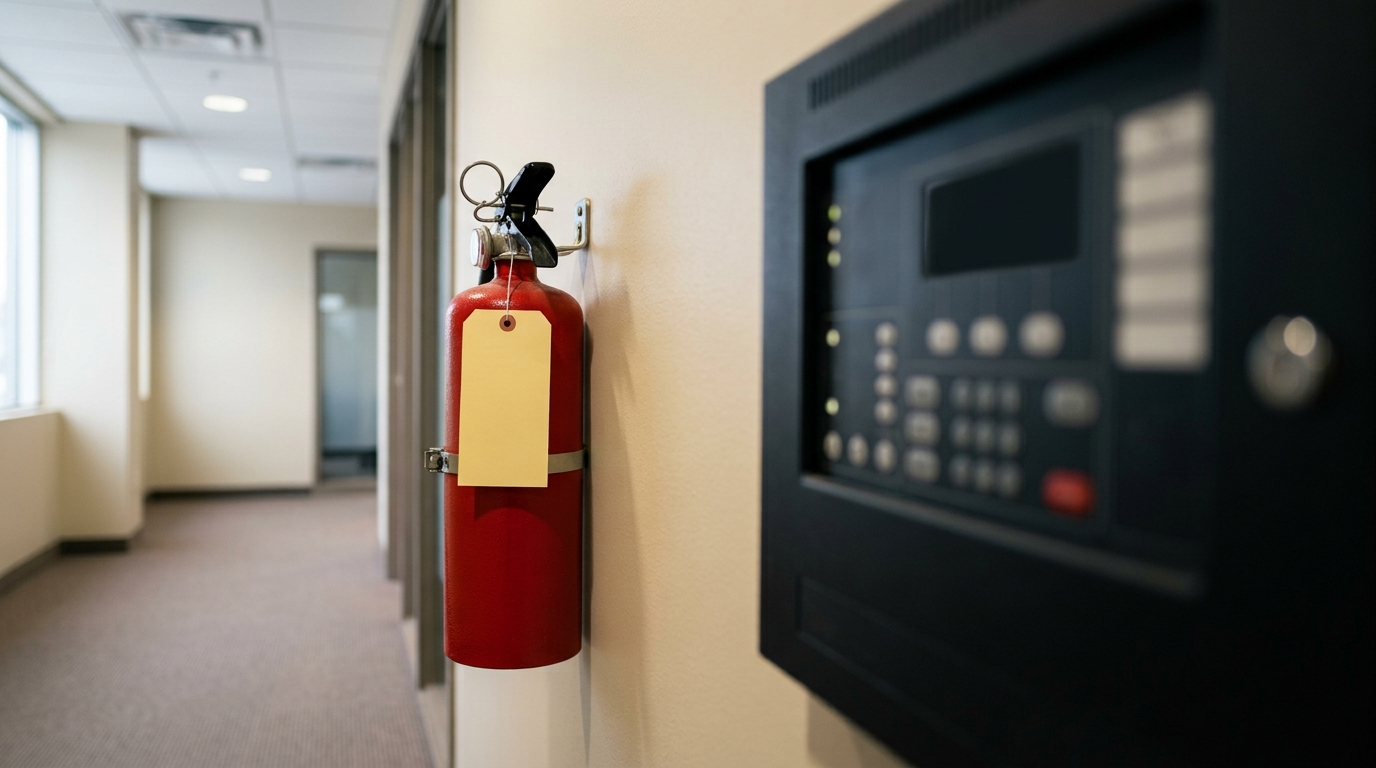
Maintenance is a requirement, not a best practice
Confusion is frequent: many operators classify equipment maintenance under discretionary expenses, to be done when the budget permits. The Quebec Safety Code dictates otherwise. Article 2.8.2.1 mandates that the fire safety plan include the inspection and maintenance of building facilities provided to ensure occupant safety. In other words, maintenance is not separate from the plan, it is part of it. We detail the document itself in our article on the workplace fire safety plan.
The Building chapter of the Quebec Safety Code, which incorporates the National Fire Code of Canada (NFC), does not rewrite maintenance procedures. It refers to recognized standards. This is why a Quebec operator must be familiar with NFPA 10, CAN/ULC-S536, and NFPA 25: they contain the frequencies that the inspector will come to check.
6,600
buildings damaged by fire each year in Quebec
Ministère de la Sécurité publique du Québec (Ministry of Public Safety), fire safety statistics 2021-2022, all sectors combined.
Portable Fire Extinguishers: What NFPA 10 Requires
The NFPA 10 standard governs portable fire extinguishers and is incorporated into the Quebec regulatory framework through the National Fire Code of Canada. It distinguishes three operations that are mistakenly grouped together under the single term of fire extinguisher inspection.
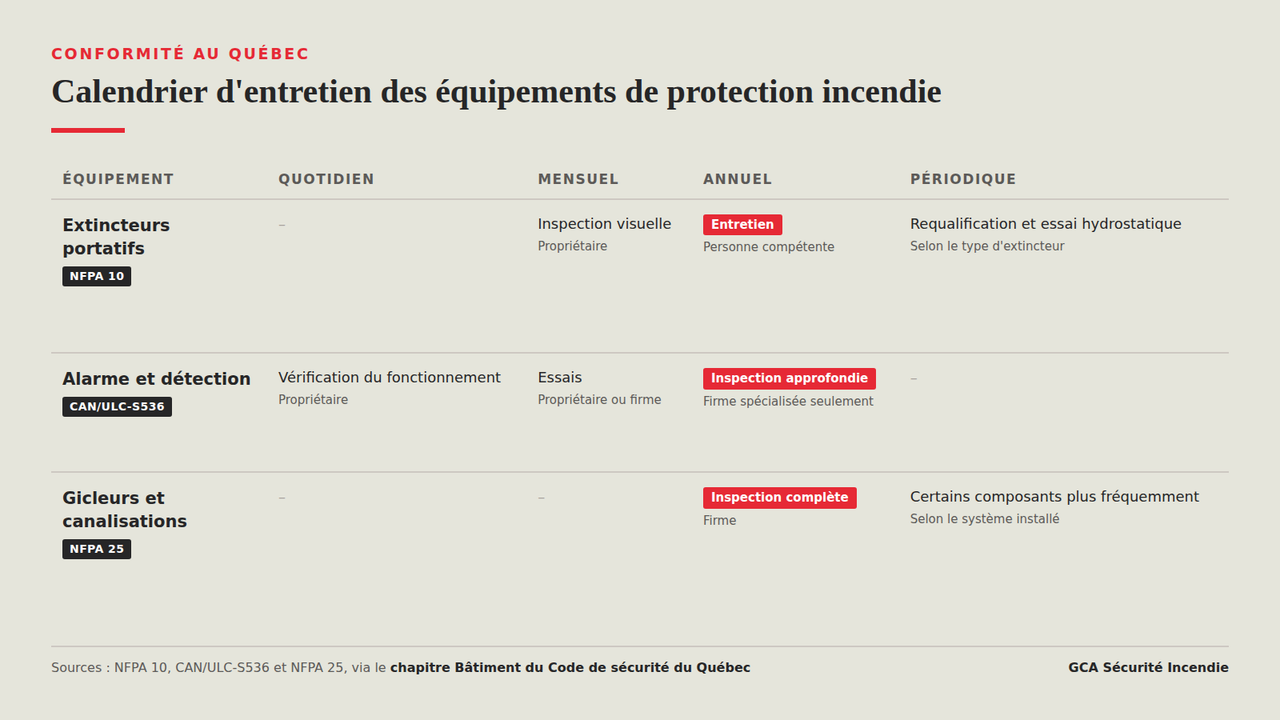
- The visual inspection, every month. It does not require a technician. You check that the extinguisher is in its place, visible, accessible, that the pressure gauge needle is in the green zone, that the pin and seal are intact, and that nothing obstructs access. It is up to the owner or their representative to do it, and to record it.
- Annual maintenance, by a competent person. This is an in-depth examination of the extinguisher, its contents, and its components. It concludes with a dated maintenance tag, the one the inspector looks at first.
- Requalification and hydrostatic testing, at longer intervals, the duration of which depends on the type of extinguisher. A dry chemical unit, a water unit, a CO2 unit, and a Class K extinguisher do not follow the same schedule. This is where you need to rely on the unit's label rather than a general rule.
Fire Alarm: The Three Levels of CAN/ULC-S536
This is the most misunderstood part of maintenance, and the one where deficiencies are the most costly. The Building Chapter requires the periodic inspection and maintenance of fire alarm systems in accordance with the CAN/ULC-S536 standard. The Régie du bâtiment du Québec (RBQ) outlines three distinct levels.
- Daily, ensure that the system is operating. The owner or their representative handles this: it is a quick look at the control panel, not a technical intervention.
- Monthly, testing covering several components of the system. This can be carried out by the owner, their representative, or a firm.
- Annually, more thorough inspections and testing of each device. This level is reserved for a specialized firm, and it concludes with a complete inspection report that must be obtained and retained.
The practical consequence is simple: an annual contract with a firm does not exempt you from daily and monthly inspections. These two levels are your responsibility, and they are the ones found missing in the majority of non-compliant files.
Sprinklers and Standpipes: NFPA 25
Water-based protection systems, automatic sprinklers and standpipes, are governed by the NFPA 25 standard, which establishes the minimum requirements for inspection, testing and maintenance. A full annual inspection by a firm is the baseline, but certain components require more frequent checks. The details depend on the type of system installed at your facility, and that is precisely why the standard is not limited to a single frequency.
Two points deserve your attention because they are not visible. A control valve inadvertently closed after work renders an entire system inoperative without any indicator light signalling it. And an unheated room through which a pipe runs becomes a freeze hazard that causes the pipe to burst during the first severe cold snap. These are two causes of loss that are completely preventable through an inspection round. As a reminder, statistics from the Ministère de la Sécurité publique (Ministry of Public Safety) record more than 6,600 buildings damaged by fire each year in Quebec.
Emergency lighting, exits and fire doors
These three elements share a characteristic: they are passive, so they are forgotten until the day they are needed. Emergency lighting must turn on during a power outage and last long enough to allow evacuation, which requires testing the switchover to battery power and not just the bulb. Exits must remain unobstructed, unlocked from the inside, and properly marked. Fire doors must close completely and latch on their own, which a wedge, a mat, or an improperly adjusted door closer prevents.
The exact frequencies applicable to this equipment depend on your usage and the building's layout. Have them specified by your fire prevention officer or your municipal fire department rather than relying on a general rule found online, especially since many French-language resources available on the web describe French regulations, which do not apply here.
The maintenance log, the document that decides
It is the cornerstone, and the most neglected. During an inspection as well as after a loss, the question is never "did you maintain your equipment" but "can you prove it". An incomplete logbook puts you in the same position as a non-existent logbook.
The date of each inspection, test, or maintenance.
The identification of the equipment concerned, with its precise location in the building.
The name of the person or firm that carried out the work.
The result observed, including anomalies.
The corrective actions taken and their date, which is often the missing link: an anomaly noted but never corrected is worse than an undetected anomaly, because it documents your knowledge of the problem.
The annual inspection reports from firms, retained in their original form.
A paper logbook in a binder remains acceptable, but it gets lost, it sends no reminders, and no one knows where it is the day the inspector shows up. That is exactly the problem that the Previo platform solves, by keeping equipment inventory, service history, and upcoming deadlines in the same place.
Who has the right to do what
The distinction between inspecting and repairing is regulatory, and it often comes as a surprise. For alarm and detection systems, the Régie du bâtiment du Québec (RBQ) specifies that inspection alone does not require a licence, but that any subsequent repair or installation must be entrusted to a contractor holding a licence, subcategory 13.2, and as applicable 16, 17.1, or 17.2.
What a lack of maintenance costs
The direct cost of annual maintenance is modest compared to what its absence entails. Three consequences compound. First, non-compliance, with notices, a correction deadline, then a statement of offence: our article on fines and prosecutions in Quebec quantifies the scope. Next, insurance, which requires proof of maintenance at the time of a claim, that is, at the worst time to discover it is missing. Finally, the manager's personal liability, which due diligence brings to the forefront as soon as an injury occurs.
If you don't know where you stand, start with an inventory. A record of the equipment present, its location, and the date of its last servicing is enough to reveal most discrepancies. This is the starting point of our inspection and tracking service, and you can also get equipped directly in our shop.