

FSP and ERP: two documents, two laws
Both plans address evacuation and end up in the same binder, but they do not answer to the same law, the same risk, or the same inspector.
| Criterion | Fire safety plan (FSP) | Emergency response plan (ERP) |
|---|---|---|
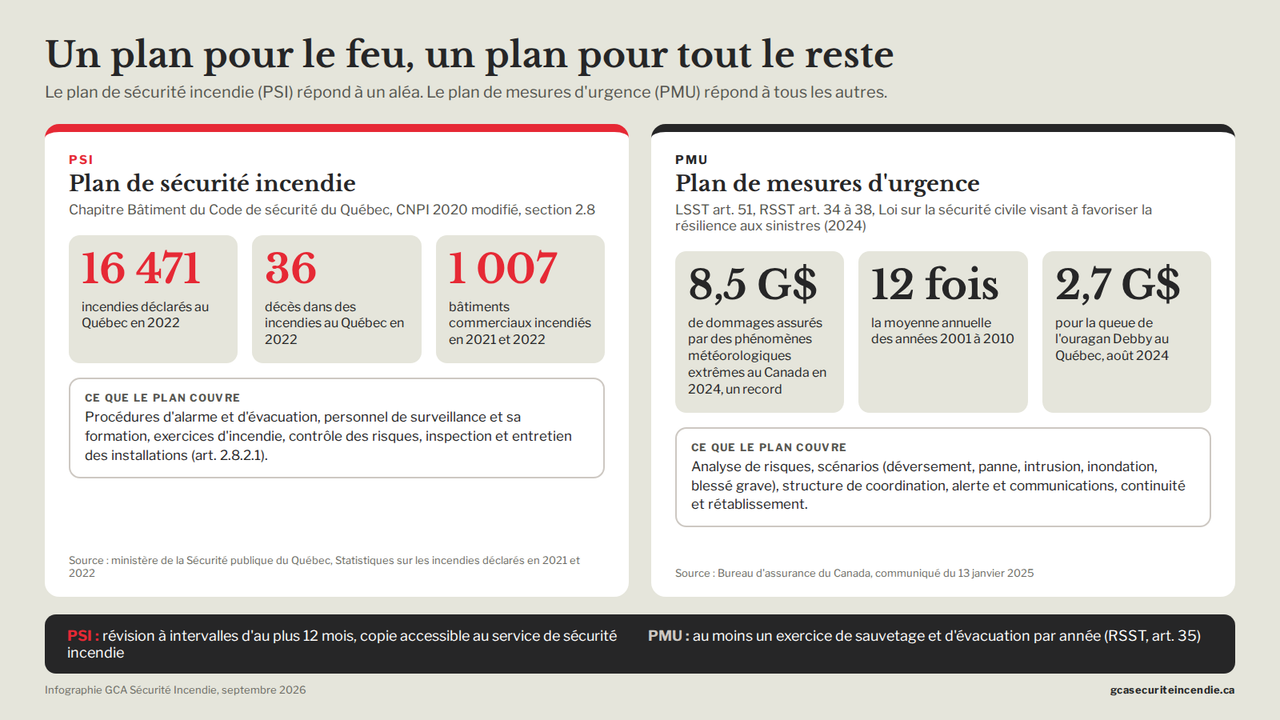
| Risk covered | Fire, in a given building | Any emergency situation: fire, spill, outage, intrusion, flood, serious injury, weather alert |
| Legal basis | Quebec Safety Code, Chapter VIII Building (NFC 2020 as amended), Section 2.8 | AOHS s. 51, OHS Reg. ss. 34 to 38, Loi sur la sécurité civile visant à favoriser la résilience aux sinistres (Civil Protection Act to promote disaster resilience, 2024), municipal and federal regulations depending on the risk |
| Who is targeted | The owner of the buildings listed in Article 2.8.1.1, depending on occupancy | Any employer, for the evacuation plan; any organisation whose activities may cause a disaster, for the rest |
| Content | The seven items of Article 2.8.2.1: procedures, supervisory staff, training, facility diagrams, drills, hazard control, maintenance | Risk assessment, scenarios, coordination structure, alerting and communications, continuity and recovery |
| Review | At intervals of not more than 12 months | At least once a year and upon any change in process, layout, or key personnel |
| Who inspects | Municipal fire safety service, Régie du bâtiment du Québec (RBQ) | CNESST for the OHS Reg., municipality for civil protection, sectoral ministries for private seniors' residences (RPAs), childcare services, and healthcare |
What is a fire safety plan (FSP) and who must have one?
The fire safety plan is the management document that describes how a specific building responds to fire: alarm and evacuation procedures, supervisory staff and their training, fire drills, hazard control, and inspection and maintenance of facilities. It is not the drawing posted in the corridor, which is the evacuation plan. Article 2.8.1.1 of the Building chapter of the Quebec Safety Code makes it mandatory for any building containing an assembly, care, treatment, or detention occupancy, for private seniors' residences, construction and demolition sites, certain storage areas, and premises where flammable or combustible liquids are stored or handled, as well as for any building whose construction requirements already provided for a plan.
An office or store outside these categories is therefore not automatically subject to it, but a municipal by-law, an insurer, or the presence of hazardous materials may require it. The plan is reviewed at intervals of no more than 12 months, and a copy must remain accessible to the fire department. The Building chapter including the NFC 2020 has been in force since April 17, 2025, according to the Régie du bâtiment du Québec, and its 18-month transition period ends on October 16, 2026. The details of the seven mandatory elements are in our article on the fire safety plan in business; to produce it in a format that the inspector recognizes, see our page on compliant FSPs in Quebec.
What is an emergency response plan (ERP) and who must have one?
The emergency response plan is based on a different logic: it does not target a building, but an organization, and all situations that may affect it. In Quebec, its foundation is the Loi sur la santé et la sécurité du travail (Act respecting occupational health and safety). Section 51 requires the employer to use methods to identify, control, and eliminate risks (paragraph 5), to take the fire safety measures prescribed by regulation (paragraph 6), and to inform and train workers (paragraph 9). The Règlement sur la santé et la sécurité du travail (Regulation respecting occupational health and safety - RSST) reflects this in Section IV, "Safety measures in case of emergency": in every establishment, an emergency evacuation plan must be established and implemented (section 34), and rescue and evacuation drills adapted to the risks must be held at least once a year (section 35). Sections 36 to 38 cover portable fire extinguishers (NFPA 10) and emergency systems. That is why one often reads "CNESST emergency response plan": the CNESST enforces these sections across all businesses, with no employee threshold or building occupancy conditions.
Since May 28, 2024, the Loi sur la sécurité civile visant à favoriser la résilience aux sinistres (Civil Protection Act to Promote Disaster Resilience) has replaced the former Loi sur la sécurité civile (Civil Protection Act). It states that every person must contribute to civil protection and exercise foresight and prudence regarding their property and activities (Section 5). It provides for a risk disclosure for persons whose property or activities may cause a disaster determined by regulation, and allows the government to impose preparedness, response, and recovery measures on them (Section 11). A municipality may also, by by-law, subject a business within its territory to these obligations (Section 12). The word "disaster" covers floods, earthquakes, hazardous materials accidents, infrastructure failures, forest fires, and pandemics: exactly what an FSP does not cover.
What hazards must the ERP cover? CSA standard Z731, "Emergency Preparedness and Response", lists ten categories, featured on the CSN (Confédération des syndicats nationaux) health and safety training portal:
- Hazardous materials spill
- Fire, gas leak and explosion
- Interruption of essential services, including power outages
- Fatalities and serious injuries requiring first responders
- Specialized rescue and medical treatment (confined space, aquatic environment)
- Workplace violence
- Sabotage, vandalism and theft
- Terrorist acts, bomb threats and riots
- Flooding
- Natural disasters: earthquake, tornado, ice storm
CSA Z731-03 has since been withdrawn from the catalogue; its successor is standard CSA Z1600:17, reaffirmed in 2022, "Emergency and continuity management program", harmonized with the American standard NFPA 1600. Facilities that hold one of the 249 substances under the federal Environmental Emergency Regulations (2019), in force since August 24, 2019, must also prepare and test an environmental emergency plan as soon as Schedule 1 thresholds are reached. To see what an up-to-date ERP looks like, with a drill log and signatures, visit our page on emergency response plans in Quebec.
8.5
$billion in insured damage from extreme weather events in Canada in 2024
A historic record, twelve times the annual average for the years 2001 to 2010. Source: Insurance Bureau of Canada, news release of January 13, 2025.
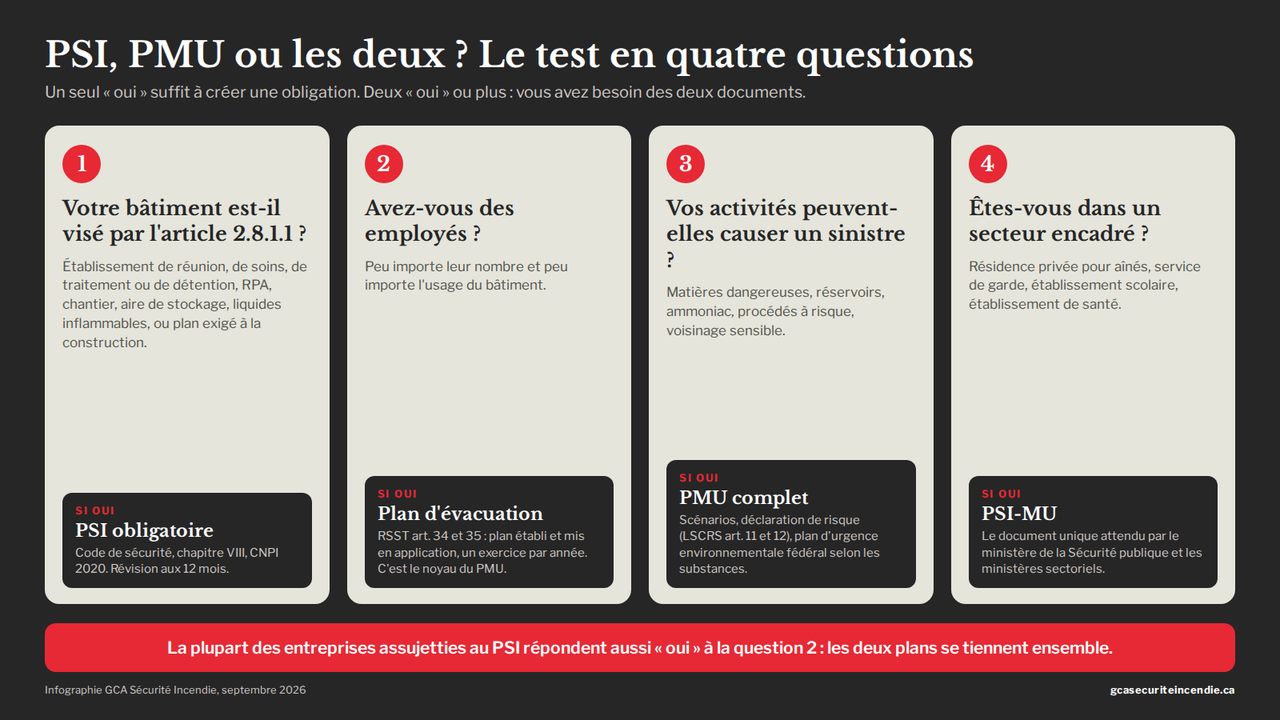
The four-question test: FSP, ERP, or both?
Answer in order. A single "yes" is enough to create an obligation.
- Is your building listed under Article 2.8.1.1? Assembly, care, treatment, or detention occupancy, private seniors' residence, construction site, storage area, flammable liquids, or a plan required during construction. If yes, the FSP is mandatory, reviewed every 12 months, with a copy accessible to the fire department.
- Do you have employees? Regardless of their number and regardless of the building's use. If yes, the RSST (Regulation respecting occupational health and safety) requires an emergency evacuation plan and one drill per year. This is the core of the ERP. Without a mandatory FSP, this evacuation plan is your minimum required document.
- Can your activities cause a disaster beyond your walls? Hazardous materials, storage tanks, ammonia systems, high-risk processes, sensitive surroundings. If yes, you need a comprehensive ERP with scenarios; a risk declaration may be required under the 2024 legislation, and depending on the substances, a federal environmental emergency plan is added.
- Are you in a regulated sector? Private seniors' residence, childcare centre, educational facility, healthcare facility. If yes, the expected document is the FSP-ERP, a single binder combining both plans. In addition, RPAs must list each resident along with their evacuation measures, and train staff upon hiring, then annually.
Two or more "yes" answers: you need both documents, and it is simpler to keep them together. Most businesses subject to an FSP also answer "yes" to the second question.
Can both be combined into a single document (FSP-ERP)?
Yes, and it is even the approach favoured by the Quebec government. The Ministère de la Sécurité publique (Ministry of Public Safety) publishes fire safety and emergency response plan templates (FSP-ERP) for residential buildings, educational institutions, and childcare services. These templates bring together in a single binder the description of the building and its facilities, the roles of the emergency team, evacuation instructions, recovery, drill history, and an appendix of potential emergencies: flooding, prolonged power outages, earthquakes, severe winds, carbon monoxide poisoning, petroleum product spills, shelter-in-place and lockdowns. In the healthcare network, the Manuel de planification des mesures d'urgence (emergency response planning manual) from the Ministère de la Santé et des Services sociaux (Ministry of Health and Social Services) plays the same role, including emergency codes.
For a business, the logic is identical: the risk assessment comes first, the ERP serves as the master plan, and the FSP serves as its fire safety chapter. A single drill log, a single emergency team, a single revision date.
What does an ERP contain that an FSP does not cover?
The FSP ends when the firefighters leave. The ERP begins before the alarm and continues after: that is the fundamental difference. The Canadian Centre for Occupational Health and Safety (CCOHS) lists what an emergency response plan must contain:
All anticipated scenarios, their consequences, and the response required for each
The emergency responder directory, with the contact information and role of each
Floor and site plans: exits, utility shut-off points, hazardous materials
The backup chain of command, when the usual structure is no longer responding
The coordination structure and the person responsible for activating it
Procedures: evacuation, assistance to the injured, liaison with external services
Backup means of communication to reach key personnel
Recovery and business continuity are also part of this. The Government of Quebec offers businesses a four-step business continuity process (analysis, design, implementation, validation through exercises) and points out that risk management, continuity planning, and insurance are part of businesses' civil protection responsibilities. Are you looking for an "emergency response plan example" or a free template? The ministry templates are public and useful for understanding the structure. They are worth nothing until they are filled in with your scenarios, your designated managers, your phone numbers, and your floor plans, and then put to the test. The CCOHS recommends a general drill and a review at least once a year, and an update with every change to facilities, processes, or key personnel. That is also what emergency response training worthy of the name verifies: that everyone knows what to do, not just that the binder exists.
What do you risk without one or the other?
On the fire safety side, notices of violation and fines fall under the Quebec Safety Code and municipal bylaws; we detail them in our article on fire safety fines and prosecutions. On the civil protection side, the 2024 law provides for a fine of $1,000 to $5,000 for a natural person and $3,000 to $15,000 in other cases for failure to submit a risk declaration or for obstructing an inspector (section 89), with these amounts doubled in the event of a repeat offence (section 93). The CNESST, for its part, can require the correction of any violation of the RSST (Occupational Health and Safety Regulation). And in court, the absence of a documented plan or drill weighs heavily in evaluating an officer's due diligence.
1
rescue and evacuation drill per year, at a minimum, in every establishment
Règlement sur la santé et la sécurité du travail (Regulation respecting occupational health and safety), Section 35. Drills must be adapted to the risks of the establishment and the nature of its activities.