
Are evacuation drills mandatory in Quebec?
Yes, and under two separate grounds that do not overlap. The first applies to every Quebec employer, whether or not they have a fire safety plan: Division IV of the Règlement sur la santé et la sécurité du travail (RSST, Regulation respecting occupational health and safety), "Safety Measures in Case of Emergency", requires that an emergency evacuation plan be established and implemented in every establishment (Section 34) and that rescue and evacuation drills be held at least once a year, tailored to the establishment's risks and the nature of its activities (Section 35). The CNESST enforces these sections. The second applies to buildings subject to the Building chapter of the Quebec Safety Code: Article 2.8.3.2 sets the frequency of fire drills based on the building occupancy, and the municipal fire safety department verifies it.
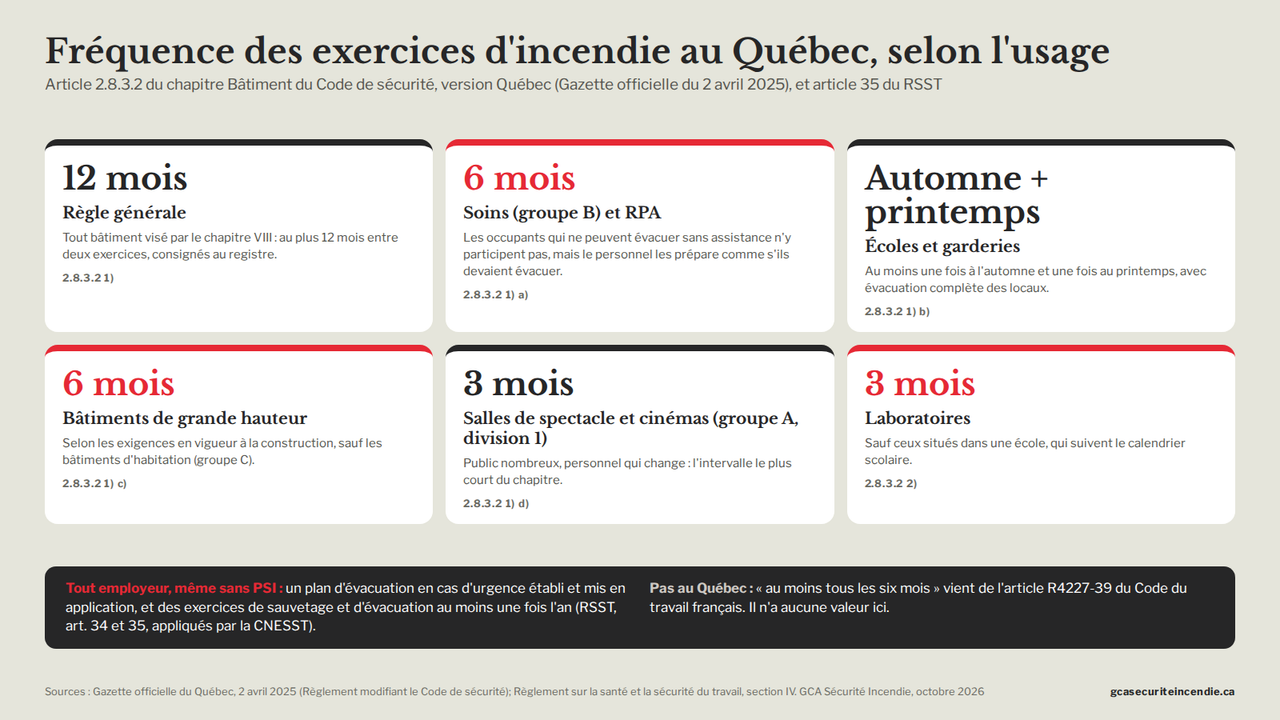
If you read "at least every six months" while looking for the rule, you came across Article R4227-39 of the French Labour Code, which Google places at the top of results in Quebec. It mandates semi-annual drills and a register kept available to the French labour inspection. It has no legal standing here. The regulations that apply in Quebec are the RSST and Chapter VIII of the Quebec Safety Code, and their frequencies are those shown in the table below.
Procedure, posted plan, safety plan: three distinct things
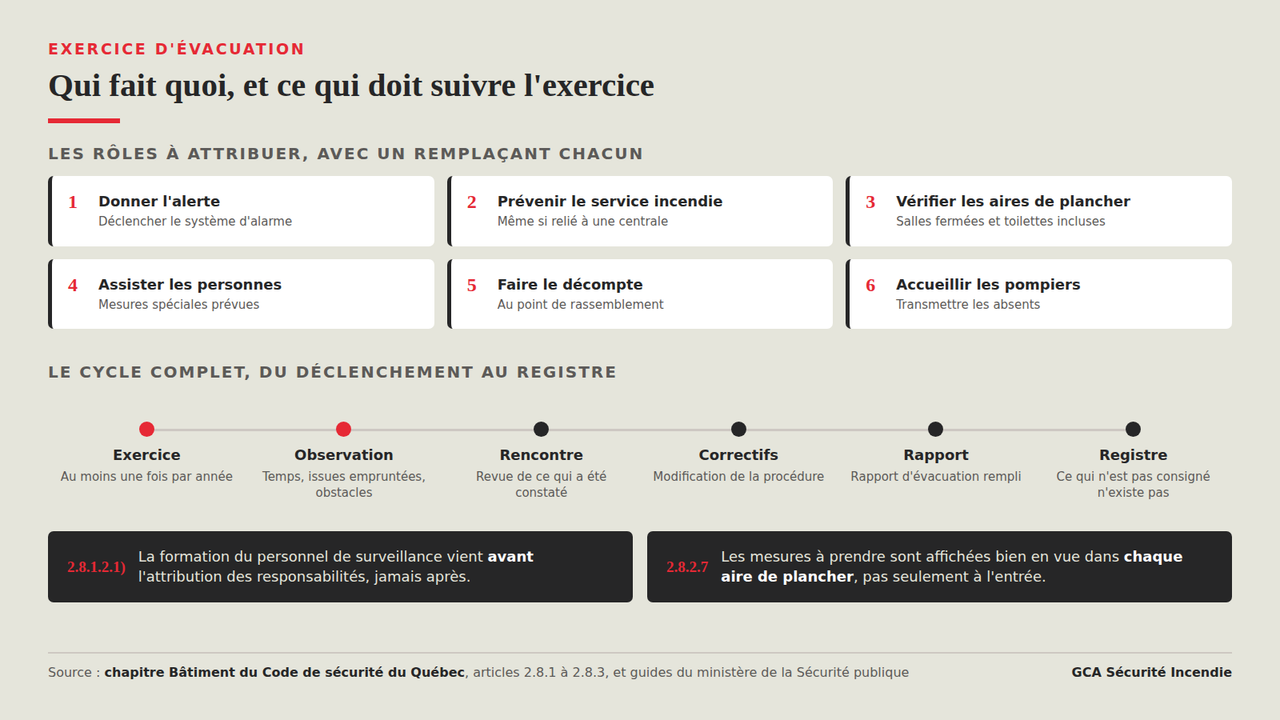
Confusion is the leading cause of non-compliance, so it is best to clear it up right away. The fire safety plan is the management document required by Article 2.8.2.1. The evacuation plan is the drawing posted in the corridors. The evacuation procedure, on the other hand, is the part that describes what people do: who sounds the alarm, who calls, who checks the floors, who takes count at the assembly point. It is the subject of this article, and it is what the drill puts to the test.
Supervisory staff must be trained beforehand
Article 2.8.1.2.1) contains a requirement whose order is almost always reversed in the field: before supervisory staff are given fire safety responsibilities, they must receive training on the emergency procedures described in the plan. Appointing someone as a floor warden and then training them "when we have time" does not satisfy the Code. A change in personnel therefore becomes a trigger for training, not merely a name correction in a document.
- Raise the alarm and activate the alarm system.
- Notify the fire department, even if the system is connected to a monitoring centre.
- Check assigned floor areas, including closed rooms and washrooms.
- Help people who need assistance and implement the special measures planned for them.
- Conduct a headcount at the assembly point and report anyone missing.
- Greet the firefighters and provide them with information about the building and missing persons.
Writing the procedure: what the Code lets you decide
Article 2.8.3.1 entrusts the procedure to the person in charge of the building, but it sets out what must be taken into account: the safety features of the building, the desirable degree of participation of occupants other than supervisory staff, and the characteristics of the installed fire safety systems, with additional requirements for high-rise buildings.
The second point is the one most often neglected. Should everyone be evacuated, or only the affected floor and the one above? In a high-rise building, a total evacuation can congest the stairwells and hinder the response. The answer depends on your building, is decided in advance, and is agreed upon with your municipal fire department. It cannot be improvised the day the alarm sounds.
1
A minimum of drill per year, recorded in the register
RSST (Regulation respecting occupational health and safety), section 35, for every establishment in Quebec. The Building chapter of the Quebec Safety Code (Article 2.8.3.2) imposes shorter intervals depending on occupancy: 6 months in care occupancies and RPAs (private seniors' residences), 3 months in performance venues and laboratories.
Posting, floor area by floor area
Article 2.8.2.7 requires displaying, prominently, in each floor area, at least one copy of the measures to be taken in the event of fire. The wording matters: this is not one poster at the entrance of the building, it is at least one per floor area. A four-storey building with a single poster on the ground floor is non-compliant, even if the poster is perfect.
Article 2.8.2.6 also requires the distribution of the plan to all supervisory staff members, and Article 2.8.2.5 requires that a copy be kept in a location determined in collaboration with the fire department. This last point often comes as a surprise: the location is not chosen alone, it is agreed upon with those who will respond to your building.
How often should the drill be conducted?
The text that matters is Article 2.8.3.2 in its Quebec version, as replaced by the regulation published in the Gazette officielle du Québec (Quebec official gazette) on April 2, 2025. Beware of copies of the national NFC text circulating online: they specify different frequencies (daycares every month, schools three times per season) that are not those in effect in Quebec.
| Occupancy | Minimum frequency | Basis |
|---|---|---|
| General rule, any building covered by Chapter VIII | At most 12 months | 2.8.3.2 1) |
| Care occupancies (Group B) and private seniors' residences | At most 6 months; occupants who cannot evacuate without assistance are prepared but not required to evacuate | 2.8.3.2 1) a) |
| Schools and daycares | At least once in the fall and once in the spring, with complete evacuation of the premises | 2.8.3.2 1) b) |
| High-rise buildings, except residential (Group C) | At most 6 months | 2.8.3.2 1) c) |
| Theatres and cinemas (Group A, Division 1) | At most 3 months | 2.8.3.2 1) d) |
| Laboratories, except those located in a school | At most 3 months | 2.8.3.2 2) |
| Any employer, with or without an FSP | At least once a year, rescue and evacuation drills | RSST (Regulation respecting occupational health and safety), s. 35 |
| Home daycare | Upon the arrival of each new child or at least every six months | Ministère de la Famille (Ministry of Families) |
When a building combines multiple uses, the primary use determines the interval, and nothing prevents aligning the entire building with the most demanding one. If you have any doubt, your municipal fire safety department will settle it in a single conversation, and they are the ones who will come to inspect anyway. No one has ever been blamed for doing one more drill than the minimum.
And where does the CNESST fit into all this?
The RSST (Règlement sur la santé et la sécurité du travail [Regulation respecting occupational health and safety]) is only one part of the regime. The Loi sur la santé et la sécurité du travail (Act respecting occupational health and safety) requires the employer to take the fire safety measures prescribed by regulation (Section 51, Paragraph 6) and to inform and train workers about the risks of their work (Paragraph 9). Since the 2021 modernization, Section 58 requires a prevention program for any establishment with at least 20 workers, and Sections 61.1 and 61.2 require an action plan below this threshold. Both documents must "take into account the regulations applicable to the establishment" and provide for supervision measures as well as the training and information of workers: the RSST evacuation plan and the annual drill therefore have their place in them, along with the name of the person in charge and the date of the last drill. The Règlement sur les mécanismes de prévention et de participation en établissement (Regulation respecting prevention and participation mechanisms in establishments), which sets the deadlines for these documents, has been in force since October 1, 2025.
Who checks what: the CNESST inspector examines the RSST (evacuation plan, annual drill, portable fire extinguishers, alarm systems, and emergency lighting, Sections 34 to 38) and the prevention program or action plan; the fire department's fire prevention officer examines Chapter VIII (fire safety plan, 2.8.3.2 frequency, register). A single well-documented drill serves both, provided the report exists. What the fire prevention officer checks, and in what order, can be found in our 30-point checklist.
Persons who cannot evacuate without assistance
The Code sets out a nuance that many managers apply incorrectly. Occupants who cannot evacuate the building without assistance, or who have health issues, are not required to participate in the evacuation during a drill. But supervisory staff must still prepare them as if they had to evacuate.
In other words, they are not made to go down four floors for a drill, but everything else is rehearsed: locating them, going to get them, checking that the transfer equipment is there and working, confirming who is taking care of it. Skipping this part because "they are not going down anyway" is precisely the mistake that the provision seeks to prevent.
What we observe during the drill
- The elapsed time between activation and the last occupant exiting.
- The exits actually used, which are rarely those anticipated by the plan: people exit the way they entered.
- The obstacles encountered: stuck door, cluttered corridor, locked stairwell.
- The behaviour at the assembly point: do occupants stay grouped together, or do they leave for their car before the head count?
- The unfulfilled roles, because the person was absent and no one took over.
- The audibility of the alarm in closed rooms, mechanical rooms, and noisy areas.
After the drill: the meeting, the report, the logbook
This is the step most often overlooked, and it is the one that transforms a drill into real improvement. A meeting is held after the drill to review what was observed. The owner or their representative then makes the necessary modifications to the procedure. An evacuation report is completed and the logbook is updated, and this applies as much to a drill as to an actual evacuation. These elements are included in the fire safety guide published by the ministère de la Sécurité publique (Ministry of Public Safety).
The logic is the same as for equipment maintenance: what is not recorded does not exist in the eyes of the authority. A drill held but not documented protects you neither during an inspection nor after a loss.
The announcement to read over the microphone
If your building has a voice communication system, prepare the text in advance rather than improvising under stress. Adapt the bracketed elements to your building and keep this announcement with the procedure.
Your attention, please. This is an evacuation drill.

Please leave your room immediately and proceed to the nearest exit using the stairs. Do not use the elevators.

Close the door behind you without locking it. Do not take your personal belongings.

Go to the assembly point located at [exact location] and remain there until the headcount is complete.

Supervisory staff are wearing [distinctive identifier]. Follow their instructions.

I repeat: this is an evacuation drill.
For an actual evacuation, remove the two mentions of drill. The rest of the text remains valid as is, which is precisely the advantage of having written it in advance. The complete regulatory framework is presented by the Régie du bâtiment du Québec, and the points checked during inspection are detailed in the Guide du préventionniste (fire prevention officer guide).