
Why do space heaters cause fires?
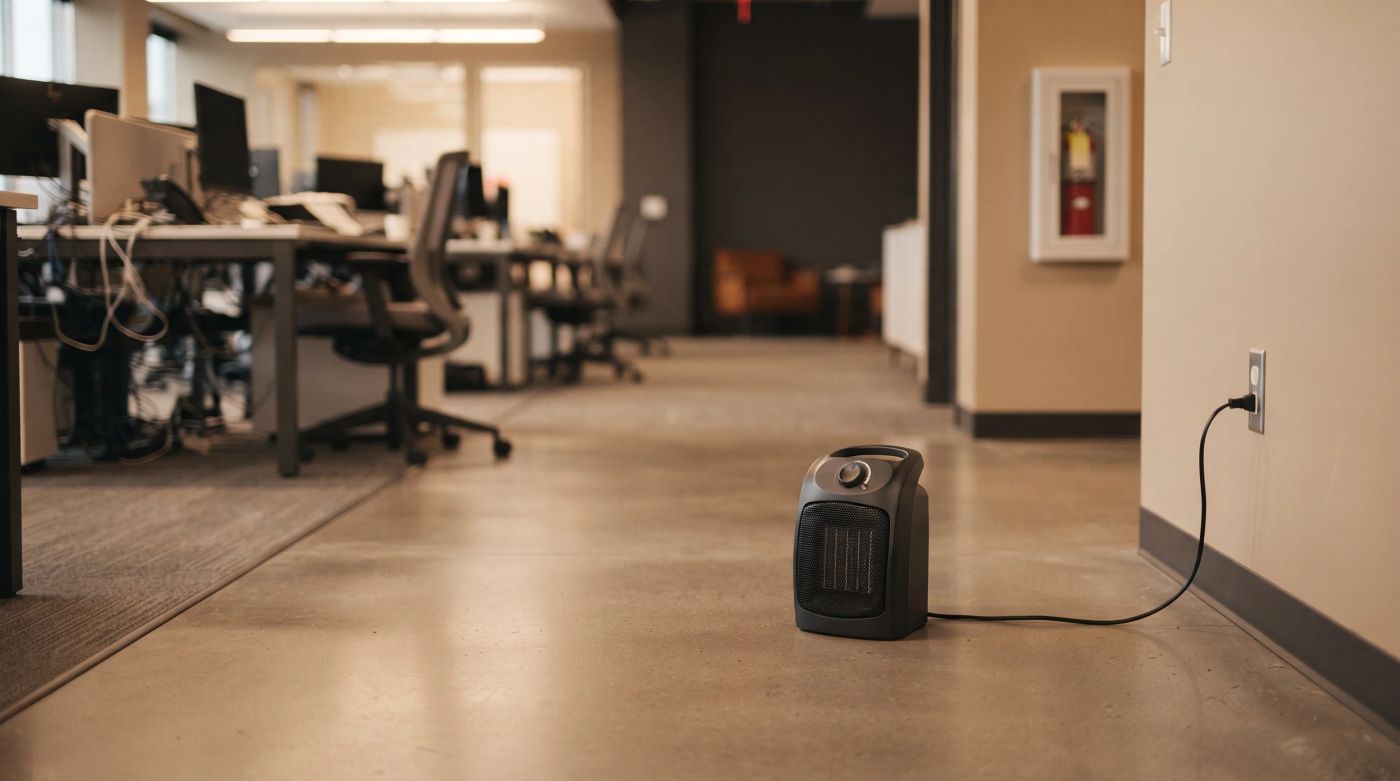
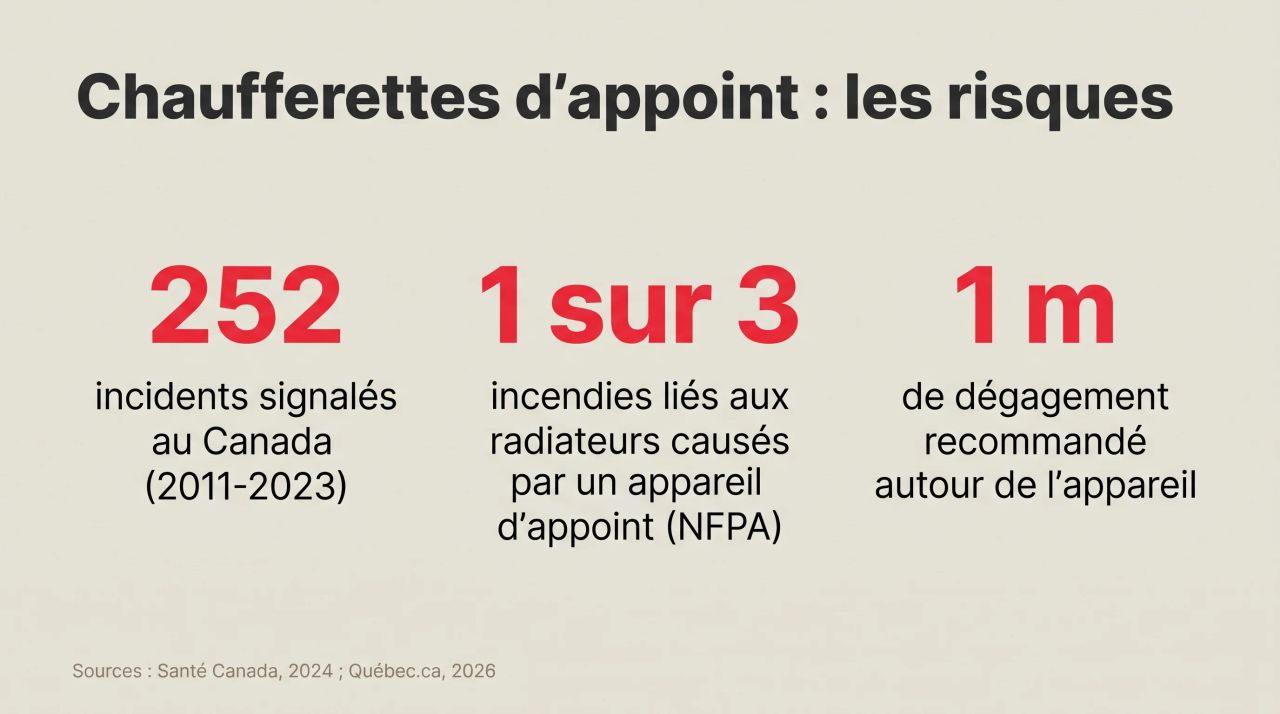
A space heater concentrates a lot of heat in a small appliance, often placed on the floor near papers, boxes, or fabrics, and plugged into whatever is within reach. Health Canada recorded 252 incident reports related to portable electric heaters between June 20, 2011, and September 30, 2023, including 5 deaths and 10 injuries. The same evaluation cites NFPA data: in the United States, 44,210 structure fires per year involved heaters from 2016 to 2020, and one-third of them were caused by space heaters, stationary or portable.
In Quebec, the 2024 annual report of the Service de protection contre l'incendie de Québec (Quebec City fire department) attributes 6% of investigated fires to a heating appliance as the heat source. The fire prevention officer guide from the Ministère de la Sécurité publique (Ministry of Public Safety) summarizes the finding: "Heating appliances, permanent or space heaters, are the cause of numerous fires."
252
incidents related to portable electric heaters reported in Canada
Health Canada, hazard assessment of portable electric heaters, updated November 28, 2024 (incidents from June 20, 2011, to September 30, 2023, including 5 deaths).
The six rules for safe use
The Preventing fire risks with electric heating page on Québec.ca, updated on February 12, 2026, and the Heating from the Service de sécurité incendie de Montréal (Montreal fire department) page converge on six rules. They are written for the home, but apply as is to the office, store, or warehouse.
- A certified appliance. Check "that the seal of a recognized certification organization such as CSA or ULC appears on the appliance." The SIM (Montreal fire department) adds: certified "for this purpose."
- 1 metre of clearance. Keep the area around the appliance clear "by at least 1 metre from any object" and let air circulate. Keep it away from furniture, curtains, and fabrics, and never place it under a cluttered desk.
- Directly into a wall outlet. "Plug the space heater directly into an electrical outlet. Do not use an extension cord."
- An automatic tip-over shut-off. The appliance must have "a built-in safety device that ensures it shuts off if tipped over," and be placed in a stable manner.
- Never left unattended. Turn off the appliance before leaving the room. At work, this means when leaving your workstation and at the end of the day.
- Never in continuous use. "Do not use a space heater (portable or not) continuously; have a compliant permanent heating system installed by a qualified person."
What do the Quebec Safety Code and the 2020 NFC say?
Chapter VIII of the Quebec Safety Code, which incorporates the 2020 NFC, does not contain an article on portable electric space heaters. Two general provisions apply to them, however. Article 2.4.7.1 requires that electrical installations be "used and maintained so as not to constitute an undue fire hazard". Article 2.4.1.1, in its version amended by Quebec, prohibits the accumulation inside and around buildings of combustible materials that, by their quantity or location, present an abnormal fire hazard. Cardboard boxes stacked against a space heater can fall under this article.
Warehouses have a more specific rule. Article 3.2.7.2 prohibits heating appliances in a fire compartment used for the storage of dangerous goods, such as flammable gases or liquids, unless they are installed in a manner that does not constitute a fire or explosion hazard.
What the CNESST expects from the employer
In occupational health and safety, space heaters fall under the employer's general duty. Section 51 of the Loi sur la santé et la sécurité du travail (Act respecting occupational health and safety) requires the employer to take the necessary measures to protect the health and ensure the safety of workers, notably by identifying, controlling, and eliminating hazards. A space heater brought from home and plugged into a power bar under a desk is precisely a risk to be identified.
The Règlement sur la santé et la sécurité du travail (Regulation respecting occupational health and safety) also addresses the issue upstream. Section 116 requires maintaining "a suitable temperature" in any enclosed premises, and Section 117 refers to Schedule IV, which sets a minimum temperature for each fixed workstation: 20 °C for light seated work, such as reading or writing, then 19 °C, 17 °C, 16 °C, and down to 12 °C for more physical work. If employees need a space heater to reach these values, it is the building's heating system that needs to be corrected.
Extension cords and power bars: the rule
The extension cord is the most common mistake with a space heater. Québec.ca prohibits it for auxiliary heating and reminds users, on its page dedicated to electricity, that "electrical extension cords are temporary solutions" and that power bars are to be reserved "for low-consumption devices such as table lamps, radios, or alarm clocks". A space heater is not one of them.
The fire prevention officer guide from the ministère de la Sécurité publique (Ministry of Public Safety) provides a useful guideline: an extension cord used for a permanent situation, meaning more than one week, must be replaced by a permanent installation or put away after each use. If a workstation needs an additional outlet, that is a master electrician's job.
Warehouses and construction sites: more specific rules
On a construction site, the Code de sécurité pour les travaux de construction (Safety Code for the construction industry) specifically regulates temporary heating (section 3.11). Any temporary heat supply must be provided by equipment "whose installation and operation present no danger." Gasoline or naphtha heaters are prohibited, and an electric heater must be certified to CAN/CSA C22.2 No. 46. A combustion heater must notably be protected against any tipping hazard and located so as not to obstruct means of egress.
Construction heaters are also subject to recalls. In 2019, Health Canada issued a recall for 240-volt electric construction heaters sold under the Chromalox, Centurion, Electromode, Westcan and Dimplex brand names: approximately 420,000 units sold in Canada, and 36 incidents reported to the company. Check recalls before bringing an old unit out of the warehouse.
Integrating space heaters into the fire safety plan
Under Article 2.8.2.1 of the NFC, the fire safety plan must provide for "measures to monitor fire hazards in and around the building." Space heaters are part of this. In practical terms: a written policy (approved appliances, certification, location), an inventory of units in service, an end-of-day walk-through, and the prompt correction of overly cold areas. The plan's content is detailed in our article on the workplace fire safety plan, and the condition of cords and outlets is part of equipment maintenance. A space heater placed against boxes or on an extension cord adds to the fire safety mistakes noted by the inspector.
SPACE HEATERS: INSTRUCTIONS TO POST
1. Only CSA- or ULC-certified units approved by the employer are permitted.
2. Keep 1 metre of clear space around the unit: no paper, cardboard, fabric, or furniture.
3. Plug directly into a wall outlet. No extension cords, no power bars.
4. The unit must shut off if tipped over. Place it flat on the floor, out of walkways.
5. Turn it off when leaving your workstation and at the end of the day.
6. Cold every day? Report it: the building's heating needs to be fixed.
Frequently asked questions
Do your employees know these rules? A fire safety training session is the right time to review them, and a pre-inspection identifies improperly placed space heaters before the fire prevention officer visits.