
What the inspector really looks at
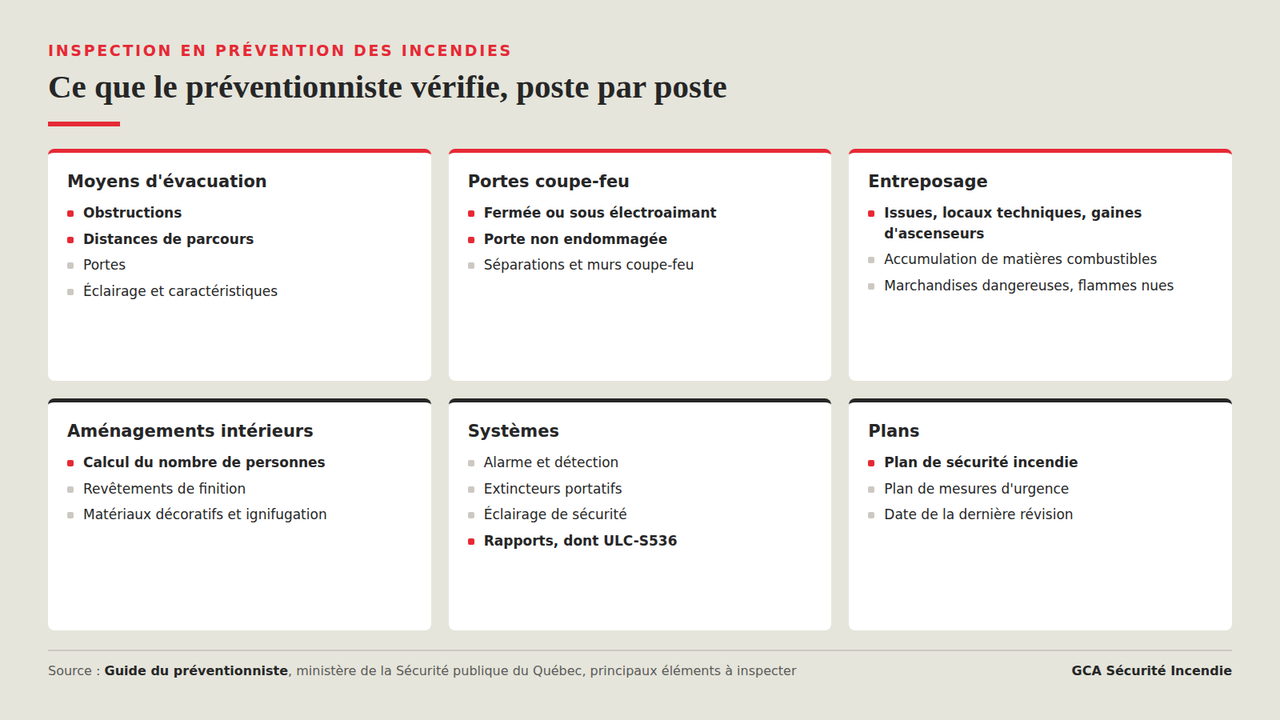
There is no mystery to uncover. The Fire Prevention Officer Guide from the Ministère de la Sécurité publique (Ministry of Public Security) contains a table entitled "Main elements to inspect during an inspection by a fire prevention officer", sourced from the Building chapter of the Quebec Safety Code. It lists the checkpoints.
Means of egress: lighting, characteristics, travel distances, doors, obstructions.
Fire separations and firewalls: door kept in the closed position or on an electromagnetic hold-open device, damaged door.
Interior layouts: signage and identification, verification of occupant load calculations, interior finishes according to flame-spread and smoke-development classifications, decorative materials in prohibited locations and their flame-retardant treatment.
Storage: accumulation of combustible materials, storage in prohibited locations such as exits, service rooms, and elevator shafts, dangerous goods, open flames, hazardous processes.
Systems: alarm and detection with ULC-S536 report, firefighting measures including portable fire extinguishers, emergency lighting. For each: operation, installation, reports.
Plans: fire safety plan or emergency response plan.
One observation stands out when reading this list: the word reports comes up for every system. Compliance is not judged solely on what is installed, but on what you can present. This is the common thread in most of the errors that follow. The stakes are not theoretical: statistics from the Ministère de la Sécurité publique (Ministry of Public Security) record more than 6,600 buildings damaged by fire each year in Quebec.
1,007
commercial buildings damaged by fire
Ministère de la Sécurité publique du Québec (Quebec Ministry of Public Security), 2021-2022 fire safety statistics. Added to this are 727 industrial buildings and 704 in the service sector.
1. Obstructing or locking means of egress
It is the most common and widespread mistake: a pallet placed "for two hours" in front of an exit, a corridor narrowed by stock, emergency exits locked in the evening to prevent intrusions. The inspection checklist explicitly targets obstructions and doors, but also a criterion that almost no one monitors: travel distances. Reconfiguring a warehouse or partitioning offices lengthens the actual travel path to the exit, and can cause a compliant building to fall into non-compliance without a single object blocking anything.
2. Propping open a fire door
The checklist is unambiguous: a fire door must be kept in the closed position, or held by an electromagnet designed to release it when the alarm is triggered. A wooden wedge, an extinguisher placed on the floor, a mat wedged under the door: in all three cases, the fire separation no longer functions, and it is precisely what must contain the fire while the occupants exit.
The inspector also checks for damaged doors. An improperly adjusted door closer that does not close completely, a torn seal, a door drilled to run a cable: all of this voids the fire resistance of the assembly. The test is within anyone's reach: release the door and see if it closes on its own and latches.
3. Storing where prohibited
The table lists the areas concerned: exits, technical rooms, and elevator shafts. These are the three spaces that naturally fill up in a growing business, because they are available and out of sight. They are also the three most dangerous: an obstructed exit traps occupants, a cluttered technical room feeds a fire at the heart of the facilities, and an elevator shaft turns a basement fire into a fire on every floor.
The checklist also covers the accumulation of combustible materials in general, dangerous goods, and open flames. A stack of empty pallets against an exterior wall, cardboard boxes stored along a corridor, a cart of cleaning products left near a boiler room: all avoidable findings through a monthly round.
4. Ignoring occupant capacity
This one surprises almost everyone. The checklist includes the verification of the calculation of the number of people, that is, the occupant capacity of the premises. It is not a rough estimate: it is calculated, it depends on the use and layout, and it determines the number and width of the exits.
The risk is real as soon as a space changes its use. A training room converted into an event space, a warehouse hosting an annual meeting, a restaurant adding an indoor patio: the use changes, so does the calculation, and yesterday's compliance says nothing about today's.
5. Decorating without considering flameproofing
The checklist covers finish coverings, evaluated based on their flame-spread and smoke-developed ratings, decorative materials in prohibited areas, and their fire-retardant treatment. In plain terms: draperies, acoustic panels, decorative drop ceilings, seasonal decorations, and wall coverings are not neutral.
This is a typical blind spot for businesses, restaurants, and meeting rooms, where remodelling is frequent and entrusted to a designer rather than a fire prevention officer. The question to ask the supplier is simple and must be asked before purchase, not after installation: what are the material ratings, and is a fire-retardant treatment required.
6. Not being able to produce reports
For alarm and detection, the checklist refers to the ULC-S536 report. For fire protection measures, including portable fire extinguishers, as well as for emergency lighting, it requires operation, installation, and reports. Three times the same word, for three different systems.
The mistake is not neglecting maintenance, it is doing it without keeping proof, or believing that an annual contract is sufficient when daily and monthly checks are your responsibility. We detail the frequencies by equipment and the contents of the logbook in our article on fire safety equipment maintenance.
7. Letting the fire safety plan expire
The checklist includes fire safety plans or emergency response plans. It is the quickest document to check, because it bears a date. The Code requires a review at intervals of no more than twelve months, and an immediate review following an alteration, a change of use, or a change in the person in charge.
An excellent plan that is three years old is a non-compliant plan, regardless of its quality. We explain who is subject to it and what it must contain in our article on the business fire safety plan. Note in passing that the fire safety plan and the emergency response plan are two distinct documents, and that the former does not exempt from the latter.
8. Treating the notice of non-compliance as a suggestion
The last mistake cannot be seen in a building; it plays out after the visit. A notice of non-compliance states what must be corrected and within what timeframe. This timeframe is the only truly comfortable window in the entire process: it lets you choose your provider, compare, and schedule the work. Letting it pass turns a maintenance issue into an infraction file, with a deadline that is no longer yours.
Our article on fines and prosecutions in Quebec details the following, including the officer's personal liability as soon as an injury occurs. If you want to know where you stand before an inspector tells you, a pre-inspection visit uses the exact same assessment grid.