
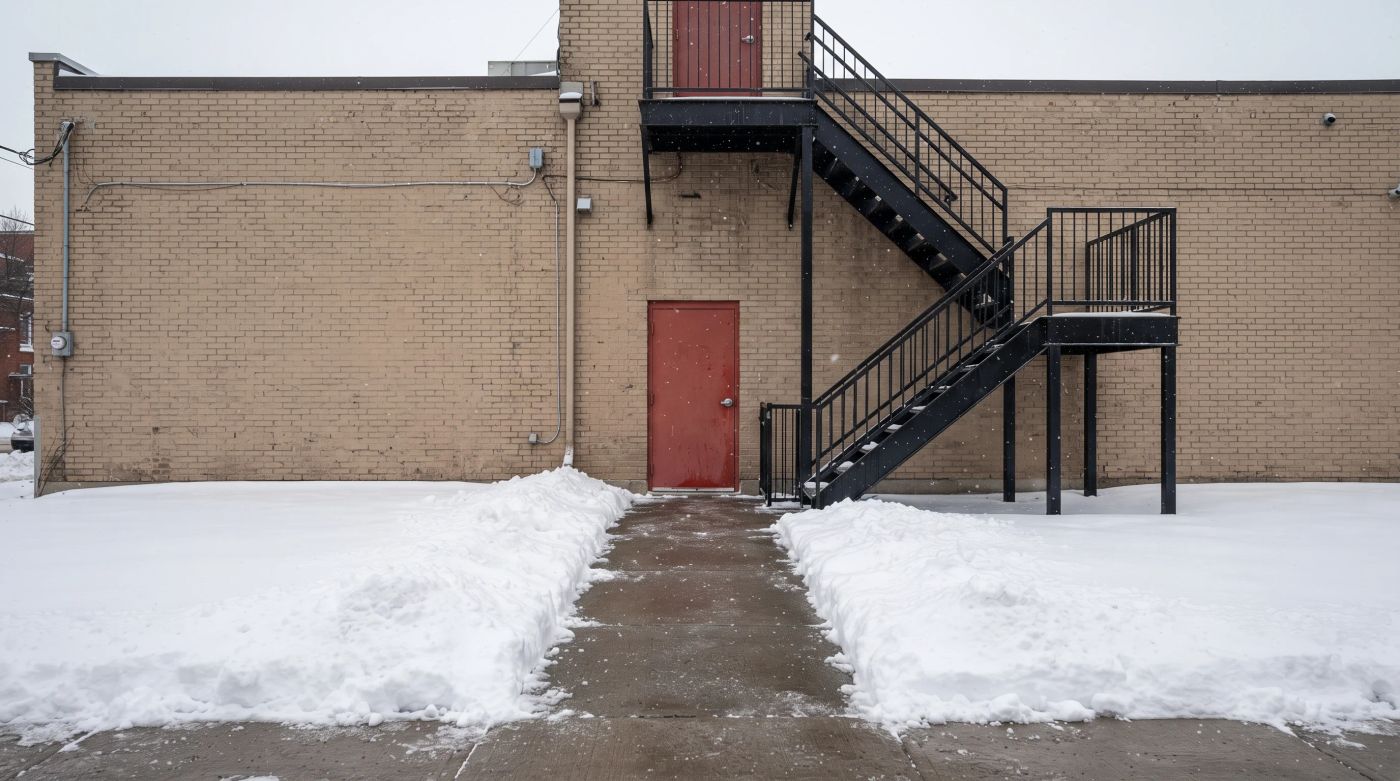
What the Code says exactly
Chapter VIII, Building, of the Quebec Safety Code incorporates the National Fire Code of Canada 2020 (NFC), with Quebec amendments published by Order in Council 438-2025. Two articles in Section 2.7, dedicated to means of egress, apply directly to winter.
2.7.1.6. Maintenance
1) Means of egress must be maintained in good condition and must not be obstructed.2.7.1.7. Exterior Exit Passageways and Stairs and Means of Exit
1) There must be no accumulation of snow or ice in exterior exit passageways and stairs of occupied buildings.
2) Windows of sleeping rooms that are required as a means of exit and located in a basement must not be obstructed by snow, any material, or an object that prevents the evacuation of occupants in an emergency.
Paragraph 2) is specific to Quebec: it replaces the national provision on snow-melting equipment. Article 2.7.1.8 completes the picture: when an exit door leading directly to the outdoors is liable to be obstructed "by parked motor vehicles or stored goods", visible signage or a physical barrier must be installed on the outside. A snowbank pushed against an exit door follows the same logic: the door must be able to open completely.
Small buildings exempt from Chapter VIII, such as a building with 8 units or fewer, fall under their municipality's fire prevention by-law, which often incorporates the NFC.
How far must snow be cleared?
No article explicitly states "all the way to the street". The answer lies in the definitions of the NFC (Division A, Article 1.4.1.2), which Quebec has not amended. An exit is that part of a means of egress that leads from the floor area "to a separate building, an open public thoroughfare, or an exterior open area not exposed to fire from the building and having access to an open public thoroughfare". Clearance therefore does not stop at the bottom of the stairs.
The Ville de Québec states it plainly: "Exits must be cleared of snow all the way to a public thoroughfare or to an open area, not exposed to fire and having access to an open public thoroughfare." If the exit opens into a backyard, the cleared path must therefore reach the street, or an open outdoor space away from the building and connected to the street.
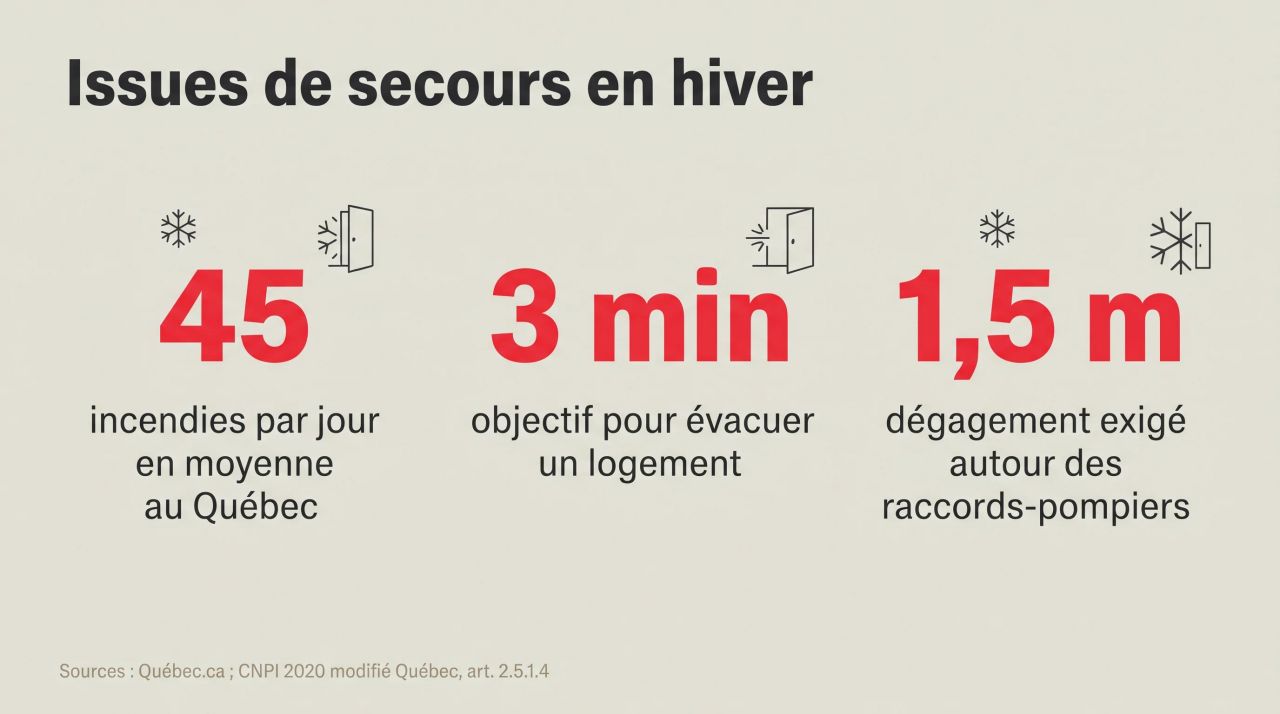
45
fires per day, on average, in Quebec
Québec.ca, Fire Safety Statistics: more than 16,600 fires per year on average, including 16,471 reported in 2022.
De-ice, not just clear snow
The text targets snow and ice. An exit stairway cleared of snow but icy is non-compliant, and this is often the most dangerous situation: a thaw followed by a freeze turns a step cleared the day before into a skating rink. Québec.ca recommends emergency exits that are "cleared of snow and de-iced", and the Service de sécurité incendie de Montréal (Montreal fire department) reminds that "properly maintaining your emergency exits is an obligation", advising that they be cleared of snow or de-iced daily.
In concrete terms: abrasives or ice melter on steps and landings, checking metal steps after each thaw, and ensuring no gutter downspout drains onto the exit route. Furthermore, the national NFC required melting equipment, such as heating cables, to remain in working order. Quebec removed this paragraph, but the obligation of result remains: no ice.
Property owner, tenant or snow removal contractor: who is responsible?
The Safety Code applies to building owners and operators. The Régie du bâtiment puts it this way: "You are responsible for the safety of the people who occupy your building or move about nearby." The snow removal contract does not transfer this obligation, it organizes its execution: if the snow removal contractor does not come, the owner remains in default before the fire safety department.
Under civil law, Article 1457 of the Civil Code of Québec requires every person to abide by the rules of conduct incumbent upon them so as not to cause injury to another. A fall on an icy exit can therefore engage the owner's liability, in addition to a statement of offence. The consequences of non-compliance are detailed in our article on fire safety fines and prosecutions.
The snow removal contract: what it must specify
Commercial insurers insist on this point. The winter maintenance guide from Northbridge Insurance recommends "establishing a written contract or service agreement that precisely defines the work to be performed as well as the roles and responsibilities of each party," obtaining a certificate of insurance from the contractor, and keeping a log of what was done, by whom, and at what time. The Office de la protection du consommateur (Quebec's consumer protection bureau), which is aimed at individuals, also provides a useful list of clauses to include. A good contract specifies:
- The trigger threshold, quantified: "5 cm of snow minimum" rather than a "snowfall" (example from the Office de la protection du consommateur [OPC - Quebec Consumer Protection Bureau]).
- The deadline by which snow must be removed, before the arrival of employees and visitors.
- The list of exits to be cleared, including emergency doors and exterior stairs, all the way to the public street.
- Related tasks: abrasives, de-icing, clearing access to doors.
- Where to deposit snow, never in front of an exit door, a basement window or a fire department connection.
- The contractor's certificate of liability insurance.
- The service log: date, time, weather conditions, work performed.
Address, natural gas, fire department connections: other points to keep clear
Firefighters must first locate the building, then connect to it. The Ville de Québec (City of Québec) reminds that "numbers or letters used to identify a building must be easily visible from the public thoroughfare", including when hidden by a snowbank. The NFC, under article 2.5.1.4 as replaced by Quebec, requires that access to fire department connections for sprinklers and standpipe systems "always" be kept clear "by at least 1.5 m". Article 2.5.1.5 requires that streets, yards, and roadways intended for fire department access be maintained usable at all times.
Finally, Énergir requires that outdoor natural gas installations (connection, meter, air intake, and exhaust pipes) be "accessible at all times" and kept "clear of any accumulation of snow or ice". Clear them using a broom or brush, never with a metal shovel, and never push snow onto them.
A winter routine to integrate into the fire safety plan
According to Article 2.8.2.1 of the NFC, the fire safety plan must provide for "measures for the control of fire hazards in and around buildings". In winter, snow on exits is part of this. Include the snow removal check in the plan, designate a responsible person, and keep the logbook with the one for fire safety equipment maintenance. The full content of the plan is explained in our article on the workplace fire safety plan. A blocked exit, whether by pallets or a snowbank, is among the fire safety mistakes noted by the inspector.
EXIT INSPECTION ROUND AFTER EACH SNOWFALL OR FREEZING RAIN EVENT
1. Open each exit door: it opens completely, without forcing.
2. Exterior stairs and landings: no snow or ice, abrasive applied.
3. Clear path from each exit to the public thoroughfare.
4. Basement bedroom windows serving as exits: unobstructed.
5. Fire department connections: 1.5 m cleared. Civic number visible from the street.
6. Gas connection and meter: cleared with a broom.
7. Log: date, time, conditions, work completed, initials.
Frequently asked questions
Do you want to know if your exits would pass inspection this winter? A pre-inspection visit uses the municipal fire prevention officer's checklist, including exterior exits.