

What ends on October 16, 2026
Chapter VIII, Building, of the Quebec Safety Code incorporates the 2020 National Fire Code of Canada with Quebec amendments. The regulation adopting it was approved by Order in Council 438-2025 on March 19, 2025, published in the Gazette officielle (official gazette) on April 2, 2025, and in force since April 17, 2025. The Régie writes, word for word, that the provisions "as they read prior to April 17, 2025, may be applied until the day preceding October 17, 2026." That day is Friday, October 16.
A single exception: Article 2.1.3.7, which covers the testing of integrated fire protection systems in accordance with standard CAN/ULC-S1001, benefits from a three-year transition period, until April 2028. Everything else in the chapter, including Section 2.8 on fire safety plans, transitions on October 17, 2026. Among the changes highlighted by the Régie itself is "compliance of fire safety plans with the Quebec Safety Code and their implementation."
18
-month transition period, from April 17, 2025 to October 16, 2026
Régie du bâtiment du Québec, Building chapter of the Safety Code including the 2020 NFC. Three years for Article 2.1.3.7 alone.
The August 2026 extension: what it covers, what it does not
On August 26, 2026, the Régie published a news release entitled "Extension of the transition period in building and electricity". Three regulations, coming into force on September 10, 2026. The first two extend the transition of the Quebec Construction Code by one year: the provisions of Chapter I, Building, prior to April 17, 2025, and those of Chapter V, Electricity, prior to March 26, 2026, remain applicable "provided that work began before October 17, 2027." These rules govern the construction and alteration of a building, and thus designers and contractors.
The third regulation amends the Quebec Safety Code. Its full text, published in the Gazette officielle du Québec of August 26, 2026 (Order in Council 1353-2026), consists of two articles. The first replaces paragraph 1 of the third paragraph of section 344 with: "the prior standard may be applied for a variable transition period, provided for by regulation, following the date on which the new standard comes into force." The second sets the coming-into-force date. No dates, no mention of Chapter VIII, no mention of October 17, 2026.
The memorial from the Minister of Labour to the Conseil des ministres (Cabinet), dated June 8, 2026, states it bluntly: the twelve-month extension amends section 6 of the regulation on the Quebec Construction Code, and "consequentially, it is also proposed to amend paragraph 1 of the third paragraph of section 344 of the Quebec Safety Code." Further on: "For the Quebec Safety Code, the amendment to section 344 must be made consequentially. There is no other option." Section 344 deals with the construction standards to which an existing building must remain compliant; it does not affect Section 2.8 or the transition end date of Chapter VIII set by Order in Council 438-2025.
| Text | Who is affected | Key date | Extended on August 26, 2026? |
|---|---|---|---|
| Construction Code, Chapter I, Building (NBC 2020 amended) | Designers, contractors, construction and alteration work | Former provisions applicable to work started before October 17, 2027 | Yes, by one year |
| Construction Code, Chapter V, Electricity | Electrical installations | Work started before October 17, 2027 | Yes, by one year |
| Safety Code, Chapter VIII, Building (NFC 2020 amended) | Owners and managers of existing buildings: FSP, drills, maintenance | Former version applicable until October 16, 2026 | No. The August 26 regulation only amends section 344, for consistency |

Why the confusion is understandable
Both codes came into force on the same day, April 17, 2025, with the same 18-month transition period. The announcement from the Régie mentions the three regulations in a single sentence, including the one for the Safety Code, under a headline about an extension. And the word "building" refers to both Chapter I of the Construction Code and Chapter VIII of the Safety Code. You have to open the actual texts to see that only the Construction Code receives a new date.
The reflex to adopt: when someone tells you that you have an extra year for your FSP, ask them for the text. The only regulation from August 26 that affects the Safety Code is a concordance paragraph, and the Régie's page on the Building chapter of the Safety Code still displays the date of October 16, 2026.
What this changes for your fire safety plan
Since April 17, 2025, a fire safety plan may comply with either the former or the new edition. As of October 17, 2026, it must comply with the new one. In practice, the fire prevention officer inspecting your FSP relies on Section 2.8 of the amended 2020 NFC: the seven elements of Article 2.8.2.1 (procedures, supervisory staff, training, facility diagrams, drills, hazard control, inspection and maintenance), training of supervisory staff before they assume their responsibilities (2.8.1.2), the copy kept in the location agreed upon with the fire department (2.8.2.5), distribution to supervisory staff (2.8.2.6), posting of the emergency procedures in each floor area (2.8.2.7), and fire drills at the prescribed frequency (2.8.3.2). The details of each element can be found in our article on what the Code requires in an FSP.
An FSP reviewed at intervals of no more than 12 months, as required by the chapter, has normally already been updated to the 2020 edition over the past year. The issue arises for dormant plans: drafted in 2022 or 2023, never reviewed, with departed managers and replaced equipment. For those, October 16 is not a formality; it is the date after which the document describes regulations that no longer exist.
Your FSP dates from before April 2025: five checks this week
The revision date. Less than 12 months, and a revision completed since April 17, 2025, therefore based on the 2020 edition. If the last recorded date is earlier, the plan must be redone.
Trained staff. The designated individuals are still in their roles, with alternates for each shift, and were trained before taking on their responsibilities (2.8.1.2, paragraph 1).
The deposited copy. One copy at the location agreed upon with the fire department, accessible at all times (2.8.2.5), and the plan distributed to supervisory staff (2.8.2.6).
Signage. The emergency procedures to be taken in case of fire posted in each floor area (2.8.2.7), and evacuation plans that match the current premises.
Recorded drills. At least one drill per year, every six months in care occupancies and private seniors' residences (2.8.3.2), with a report in the logbook for each.
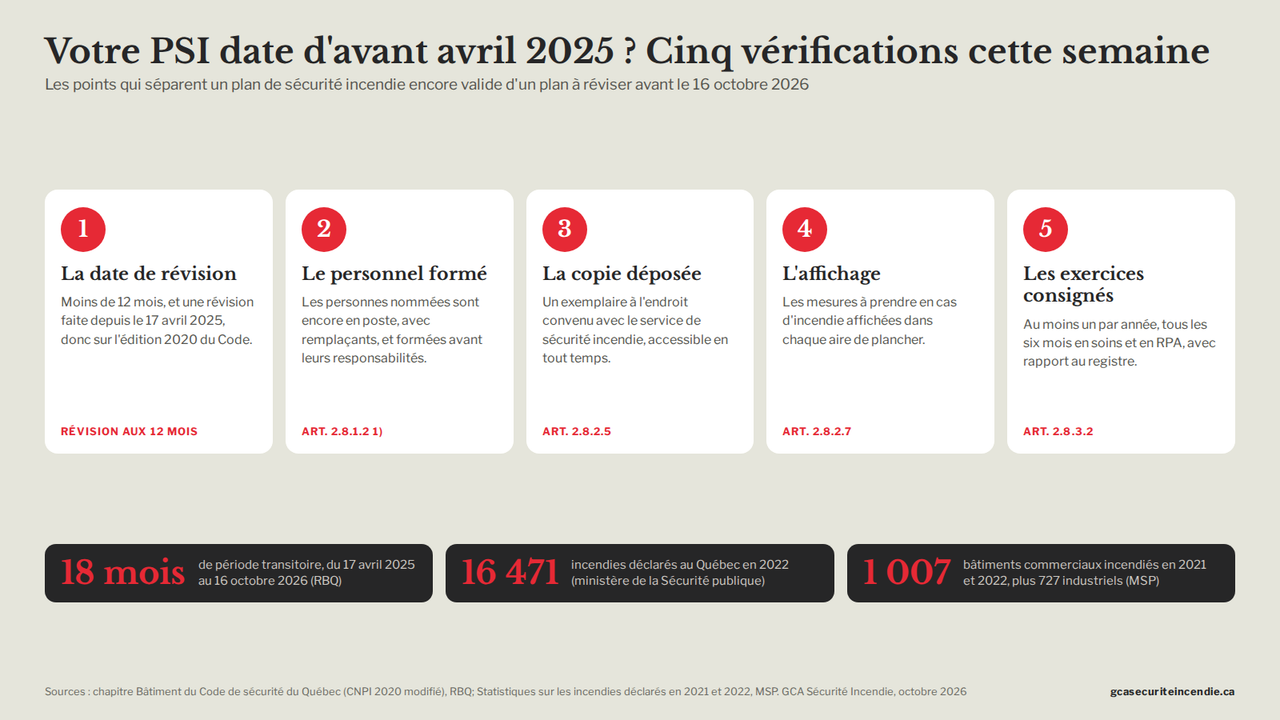
If you are expecting a prevention visit, our 30-point checklist covers these items in the order the fire prevention officer reviews them.
Who does this apply to?
The obligation to have a fire safety plan depends on the building's use, not the size of the business. Article 2.8.1.1 specifically targets buildings containing an assembly, care, treatment, or detention occupancy, private seniors' residences, construction and demolition sites, certain storage areas, and locations where flammable or combustible liquids are stored or handled, as well as any building whose construction requirements already called for a plan. A municipal by-law or an insurer may require it elsewhere. The October 16 date applies to all these buildings, without distinction. And if you are hesitating between an FSP and an emergency response plan, the four-question test settles it in two minutes.
1
more year for the Construction Code, none for the Safety Code
Memorandum from the Minister of Labour to the Conseil des ministres (Quebec Cabinet), June 8, 2026, and regulations published in the Gazette officielle du Québec (Quebec Official Gazette) on August 26, 2026 (numbers 88907, 88908 and 88909).
Frequently asked questions
With Previo, the revision date, designated individuals, training, and the drill log live in the same place, with reminders before each deadline. The next code change will not catch you off guard.