
Which text applies to your building?
Chapter VIII, Building, of the Quebec Safety Code applies to owners of existing buildings. However, Section 340 exempts buildings used for residential purposes that have at most 2 storeys in building height or contain at most 8 dwellings. It therefore applies to buildings with 3 storeys or more and 9 dwellings or more, as well as to all private seniors' residences (RPA). The exemption applies to single-use buildings: a building with a commercial space on the ground floor warrants verification.
A duplex, triplex, or small 6-unit building falls under the fire prevention by-law of its municipality. The Quebec Construction Code, based on the National Building Code of Canada 2020 as amended for Quebec, governs the alarms required during new construction or renovation.
| Your building | Text that applies to alarms |
|---|---|
| Building with 3 storeys or more and 9 units or more | Quebec Safety Code, Chapter VIII, sections 353 to 360 |
| Private seniors' residence, all sizes | Quebec Safety Code, Chapter VIII, with requirements specific to RPAs |
| Duplex, triplex, building with 8 units or fewer | Municipal fire prevention by-law |
| New construction or alteration | Quebec Construction Code, Chapter I (NBC 2020 modified for Quebec) |
Owner or Tenant: Who Does What?
The Quebec Safety Code applies to the owner and does not mention the tenant. The division of responsibilities comes from elsewhere. The leaflet from the ministère de la Sécurité publique (Ministry of Public Safety) summarizes it as follows: "Owners must provide smoke alarms in good working order and tenants must check them, maintain them and replace the batteries, if applicable."
Municipal by-laws translate this division into obligations. In Quebec City, sheet 171 of the Règlement sur la prévention des incendies (fire prevention by-law) specifies that the alarm must be "continuously maintained in perfect working order by the occupant and replaced by the owner when it is defective, painted or more than 10 years old." Montreal applies the same division: the owner provides and installs, the occupant maintains.
| Task | Who is responsible | Legal basis |
|---|---|---|
| Supply and install required smoke alarms | Owner | Quebec Safety Code, s. 353; municipal by-laws |
| Install the CO alarm when required | Owner | Quebec Safety Code, s. 359; municipal by-laws |
| Inspect and keep the device in working order | Tenant (occupant) | Municipal by-laws; MSP (Ministère de la Sécurité publique - Ministry of Public Safety) leaflet |
| Change the battery as needed | Tenant (occupant) | Municipal by-laws; MSP leaflet |
| Replace a defective, painted, or more than 10-year-old device | Owner | Quebec Safety Code, s. 358; Ville de Québec, fact sheet 171 |
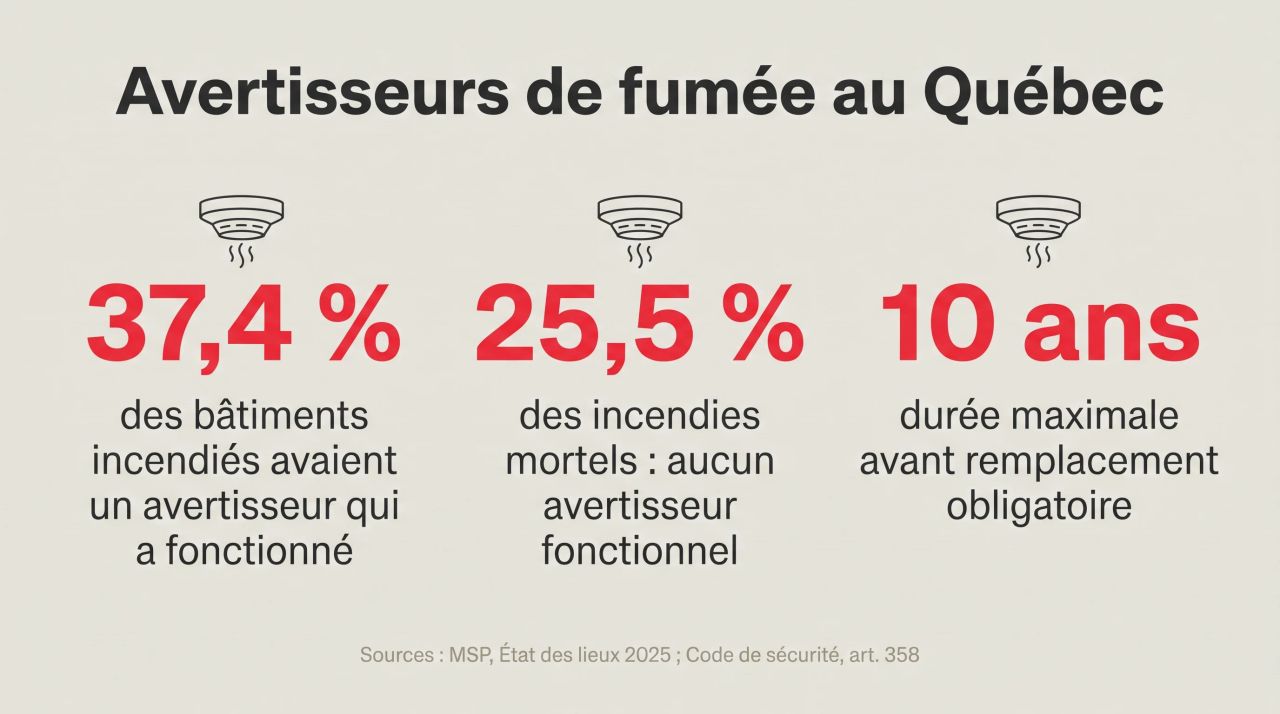
37.4 %
of fire-damaged buildings had a smoke alarm that worked
Ministère de la Sécurité publique (Ministry of Public Safety), Fire Safety Overview, April 2025 (2014 to 2022). In 38.2% of cases, no alarm or an inoperative alarm.
Test every month, replace after 10 years
Québec.ca recommends testing smoke alarms every month by pressing the test button for a few seconds, and cleaning them every year. This monthly test is a recommendation addressed to the occupant, not a provincial requirement. One rule applies to everyone: never paint a smoke alarm.
Replacement, however, is mandatory. Section 358 of the Quebec Safety Code is unequivocal: "Every smoke alarm must be replaced 10 years after the date of manufacture indicated on the casing. If no date of manufacture is indicated on the casing, the smoke alarm is considered non-compliant and must be replaced without delay." You count from the date of manufacture, not installation.
Montreal also requires that, in apartment buildings, smoke alarm inspections be recorded at least once a year in a logbook. Elsewhere, this logbook remains the best proof during an inspection, as with the maintenance of other fire safety equipment, and it helps you avoid one of the mistakes inspectors flag: being unable to prove what was done.
Intermittent beeping: what to do?
Québec.ca asks that batteries be replaced “when you hear an intermittent sound signal and when you move into a new home.” The page sets no schedule: the guideline to change batteries twice a year, often associated with the time change, does not come from Québec.ca. Some cities keep it as advice, such as Ville de Québec (City of Québec), which suggests replacing the battery every six months.
Three habits simplify managing a housing portfolio. Choose 10-year lithium battery models, which Québec.ca recommends: the battery lasts as long as the device. Never replace an alarm connected to the electrical circuit with a battery-powered model. And remind tenants never to remove the battery from a device that goes off near the kitchen: instead, move it slightly farther away.
Carbon Monoxide: When Is the Alarm Mandatory?
For existing buildings subject to Chapter VIII, Section 359 of the Quebec Safety Code requires a carbon monoxide alarm “in a dwelling unit, a residence for the elderly or a supervised residence” that contains “either a fuel-burning appliance” or “direct access to an indoor parking garage”. Section 360 specifies that the device must comply with standard CAN/CSA-6.19, be equipped with an integrated alarm, and be installed according to the manufacturer's recommendations. The Régie du bâtiment du Québec (RBQ) carried forward this requirement in the edition of the chapter based on the NFC 2020.
In new construction or alterations, Article 9.32.3.9 of the National Building Code of Canada 2020, incorporated into the Quebec Construction Code, applies to any building that houses a dwelling and contains a fuel-burning appliance or a parking garage. For smaller buildings, municipal regulations take over. In Montreal, the Service de sécurité incendie (fire department) requires property owners to install a CO alarm in both of these situations; the occupant must keep it in place and replace the battery as needed.
Where to install alarms, and where to avoid them
Québec.ca recommends a smoke alarm on every floor, including the basement, in the hallway near the bedrooms, in each bedroom where someone sleeps, and near stairs, mounted as follows:
- On the ceiling, at least 10 cm (4 in.) from the wall, or on the wall, between 10 and 30 cm (4 to 12 in.) from the ceiling.
- 1 metre (40 in.) from a fan, air conditioner, or air supply or return vent, where air movement can push smoke away.
- Unobstructed, so that smoke can reach the device.
- Slightly away from the kitchen and bathroom if the device triggers false alarms.
For carbon monoxide, add the door to the attached garage and the room located above it to the same locations. Québec.ca advises against the kitchen, the bathroom, the interior of a garage, a cathedral ceiling, an outlet controlled by a switch, and any location less than 2 metres from a cooking or combustion appliance.
What Montreal and Quebec City require in addition
A municipality may go further than the Quebec Safety Code. In the Urban Agglomeration of Montreal, the Règlement sur le Service de sécurité incendie (fire safety department by-law, RCG 12-003) requires alarms with a 10-year non-removable lithium battery in residential buildings constructed before 1985, and alarms connected to an electrical system in those constructed after. The annual log described above is an additional requirement for apartment buildings.
In Quebec City, the Règlement sur la prévention des incendies (fire prevention by-law, R.V.Q. 2241) has required a CO alarm since April 1, 2019, when a combustion appliance is present, or when a wall, floor or ceiling is adjacent to a room containing such an appliance or to a parking garage. Elsewhere, ask your fire safety department which by-law applies: they will be the ones conducting the inspection.
Private seniors' residences: a more demanding framework
RPAs do not benefit from any exemption under Chapter VIII, regardless of their size. The Quebec Safety Code also requires a fire detection and alarm system, interconnected alarms, the Section 359 CO alarm, and, for older buildings, sprinklers according to a regulatory timetable. An RPA must also have a fire safety plan and train its staff on it: the required content is detailed in our article on the fire safety plan for businesses.
Frequently asked questions
Do you manage multiple buildings or a private seniors' residence (RPA)? A pre-inspection visit uses the municipal fire prevention officer's checklist and tells you, device by device, where you stand before the inspection.